Which Flexstone Grade Should You Pick for a Weak-Solvent Printer? FS-S and FG-S Specifications Compared
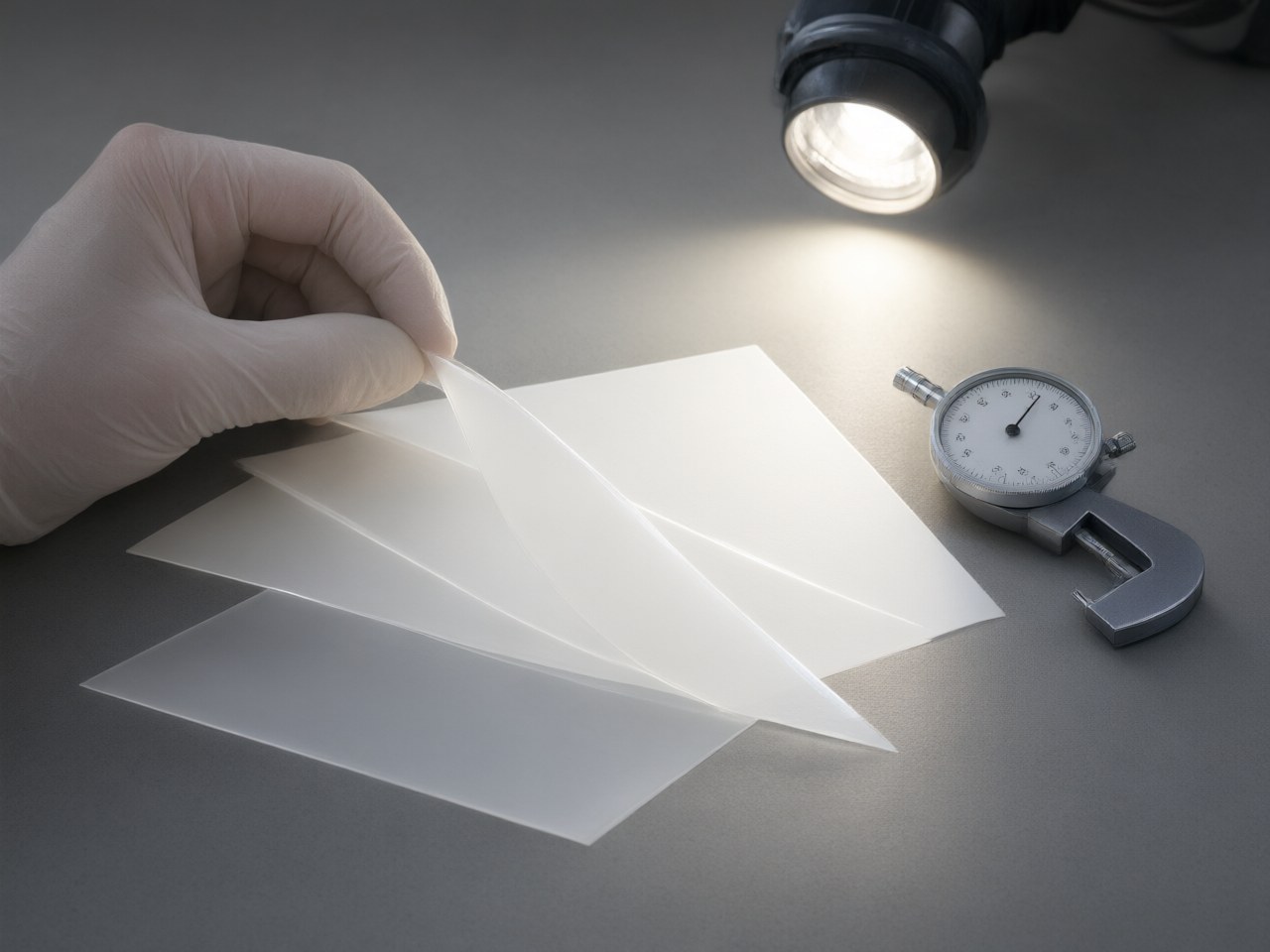
For a weak-solvent (eco-solvent) wide-format printer, start with a non-adhesive S-coating grade that the specification sheet lists for (weak) solvent inkjet. Newlife’s published S-coating process list is (weak) solvent inkjet, HP Latex and wide-format UV inkjet — “UV” here means wide-format UV inkjet, not UV-curable ink on an offset or label press. FS-S and FG-S are that coating on two density series: FS at 1.0 g/cm³ (soft, lightweight, paper-like) and FG at 1.4 g/cm³ (stiff). At the same thickness, the FG density (1.4 g/cm³) is 40% higher than FS (1.0 g/cm³). Published basis weight is higher on FG, but the sheet figures are not a flat 40% scale of the FS weights. Choose FS-S for lower basis weight and paper-like handling; choose FG-S when you want the stiffer sheet and can accept the extra mass. Do not order FS-S22-PSA for this printer: that self-adhesive construction is annotated for HP Latex only. Any other self-adhesive S-coating part number has to be checked on its own sheet before it is treated as a weak-solvent grade. No process-temperature ceiling is published for S-coating grades, and Flexstone is not a long-term outdoor or fire-rated substitute for PVC.
The practical question is no longer whether an S-coating grade will accept (weak) solvent ink. It is which published non-adhesive grade — FS-S22, FS-S32, FG-S22, FG-S27 or FG-S32 — suits the roll handler, the finishing line and the end use. The comparison below uses published density, the S-coating process list and the published basis weights for these five grades. A thickness suffix that is not on the specification table is not an orderable grade, including an intermediate FS step between 0.22 mm and 0.32 mm that the table does not list. Contractual thickness, basis weight and process list for a purchase are the figures on that model’s specification sheet.
FS-S and FG-S use the same S coating on different density series
FS-S and FG-S are not two coatings. Both are S-coating grades. What changes is the base sheet: FS is the 1.0 g/cm³ series, FG is the 1.4 g/cm³ series, and the third published series, FM, is 1.2 g/cm³. This guide does not assign FM part numbers. Published S-coating gloss is 3–8°, so gloss does not separate FS-S from FG-S. Whiteness and opacity are published by model group on the specification sheet; do not treat either density series as “higher opacity”. Catalogue grades are warm white and opaque. Handling, stiffness and mass are the split, because FS is described as soft, lightweight and paper-like, and FG as stiff. The grades sit in the inkjet media series.
Nominal basis weight is the specification that actually changes across the published grades
Grade codes follow Newlife’s thickness encoding (the numeric suffix in hundredths of a millimetre), the same encoding used for published part numbers such as FS-S22-PSA. The encoding does not create a grade. Nominal basis weight below is the published sheet figure for the five non-adhesive grades in this comparison, including the published tolerance, not a recalculation that overwrites the sheet. The non-adhesive relationship is approximate. Confirm both figures on the model specification sheet before you treat them as a purchase specification.
| Grade | Density series | Nominal thickness | Nominal basis weight | S-coating process list | Source and limit |
|---|---|---|---|---|---|
| FS-S22 | FS, 1.0 g/cm³ | 0.22 mm | 220±22 g/m² | (weak) solvent, HP Latex, wide-format UV inkjet | Published sheet figure. No published temperature ceiling. Sheet basis weight governs the order. |
| FS-S32 | FS, 1.0 g/cm³ | 0.32 mm | 320±32 g/m² | Same S-coating list | Published sheet figure. Same limits. No intermediate FS thickness is added between this row and FS-S22. |
| FG-S22 | FG, 1.4 g/cm³ | 0.22 mm | 300±30 g/m² | Same S-coating list | Published sheet figure. Stiffer series, not a higher-opacity series. |
| FG-S27 | FG, 1.4 g/cm³ | 0.27 mm | 370±37 g/m² | Same S-coating list | Published sheet figure. Same limits. This 0.27 mm step is an FG grade, not an FS grade. |
| FG-S32 | FG, 1.4 g/cm³ | 0.32 mm | 440±44 g/m² | Same S-coating list | Published sheet figure. Highest published basis weight in this set. |
Source: density series, S-coating process list and basis weight from Newlife published grade data. The non-adhesive relationship W (g/m²) ≈ t (mm) × ρ (g/cm³) × 1000 is approximate and does not replace the sheet figures. Wide-format inkjet roll supply is listed as 50 m × 1270 / 1370 / 1524 mm. A product sheet also lists a material width of 1600 mm — confirm which widths the exact model is offered in; do not assume every SKU is stocked in every width. Specification sheets: downloads.
FS-S32 and FG-S22 land close on published nominal grammage (320±32 g/m² versus 300±30 g/m²) and far apart in the hand: one is a thicker 1.0 g/cm³ sheet, the other a thinner 1.4 g/cm³ sheet. If the criterion is grammage, those two compete. If the criterion is stiffness at a given thickness, compare FS-S22 with FG-S22, not FS-S32 with FG-S22. There is no published FS row at 0.27 mm to set against FG-S27; do not invent one from the thickness code.
Non-adhesive basis weight is approximately thickness times density times 1000
For non-adhesive grades, Newlife publishes W (g/m²) ≈ t (mm) × ρ (g/cm³) × 1000. Use it to audit a quotation. It is not a licence to overwrite the specification sheet: the relationship is approximate, and the sheet nominal is the purchasing figure. The grades in this comparison publish a ±10% basis-weight tolerance — 220±22, 320±32, 300±30, 370±37 and 440±44 g/m² — so plan yield around that published band, on the grade you actually order.
The published FS nominals in this set fall on the formula: 0.22 × 1.0 × 1000 = 220 g/m² and 0.32 × 1.0 × 1000 = 320 g/m². The FG published nominals are 300, 370 and 440 g/m², not the raw products 308, 378 and 448 g/m². A quoted basis weight that differs from the formula is not automatically wrong; the sheet figure governs. Do not run the formula at an FS thickness the specification table does not list and then treat the product as a catalogue nominal.
Roll mass for lifting and freight is M (kg) = W (g/m²) × width (m) × 50 (m) / 1000. These are calculations from the published nominal basis weight (the centre of the published tolerance) and the listed 50 m inkjet roll length, not weighed catalogue roll weights. Substitute the sheet basis weight when you have it.
- FG-S27 at 1270 mm: 370 × 1.27 × 50 / 1000 ≈ 23.5 kg over 63.5 m². - FG-S32 at 1270 mm: 440 × 1.27 × 50 / 1000 ≈ 27.9 kg over 63.5 m². - FG-S32 at 1524 mm: 440 × 1.524 × 50 / 1000 ≈ 33.5 kg over 76.2 m². - Light end of this set: FS-S22 at 1270 mm ≈ 14.0 kg.
Across the five grades and the three listed inkjet widths, calculated roll mass runs from about 14 kg to about 33.5 kg. That is a decision about roll-loading hardware, lifting practice, freight and storage. It is separate from how long an opened roll may be kept: where a specification sheet requires unused material to be finished within one month, that clause applies whatever the roll weighs. Do not apply that clause to a grade whose own sheet does not state it.
Weak-solvent compatibility does not come with a published temperature ceiling
Non-adhesive S-coating grades are the grades mapped to (weak) solvent, HP Latex and wide-format UV inkjet. Printability is still published by model group, so match the part number on the specification sheet rather than ordering from the coating name alone. Process mapping is set out in printing on stone paper.
Two ordering traps are already documented and are easy to miss:
- FS-S22-PSA is annotated for HP Latex only (NMEQS-MACO 297). It is not a (weak) solvent product. A shared numeric suffix with a non-adhesive FS-S grade does not transfer the process list. That Latex-only limit is not true of every pressure-sensitive S-coating grade: FS-S22-PSA-80G and FS-S22-WRA-80G (NMEQS-MACO 294) are annotated for (weak) solvent, HP Latex and wide-format UV inkjet, supplied as 50 m rolls at 1270 / 1370 / 1524 mm, single-sided. Read every other PSA construction on NMEQS-MACO 297 from that sheet; do not assume it shares the non-adhesive S-coating process list. - Wide-format K-PSA rolls in NMEQS-MACO 294 are documented for wide-format UV inkjet, not as a (weak) solvent S-coating substitute. FS-K15-PSA-80G and FS-K20-PSA-80G are listed at 1270 / 1370 mm only.
If the job needs adhesive, use the self-adhesive inkjet range and read the process list on that construction’s sheet. FS-S22-PSA-80G and FS-S22-WRA-80G are published S-coating part numbers for (weak) solvent; do not substitute FS-S22-PSA for them, and do not invent other “-80G” or WRA suffixes the sheet does not list.
No long-term or short-term process temperature is published for FS-S or FG-S. Published temperature figures exist only for two other groups: FS/FG 2K at 0.15–0.30 mm (long-term 80°C; short-term 100°C for FS and 120°C for FG; NMEQS-MACO 293) and the FG digital-press specifications (long-term 80°C, short-term 120°C; NMEQS-MACO 298). Do not copy those ceilings onto an S-coating grade. Weak-solvent and HP Latex printers both use heat to dry or cure. Heater setting, ink load, lamination and heat-assisted mounting are not published process parameters for these grades. Test them on a short sample before committing a roll. Useful checks are head clearance with no head strike, edge curl or buckle after the heater, dimensional change, ink adhesion after your normal dry time, and flatness after any downstream heat.
Working environment, storage conditions and shelf life are published per specification-sheet model. They are not one band that can be merged across FS-S and FG-S grades, and they are not published for grades that appear only in the solution booklet. Read the working temperature, storage temperature, humidity and shelf-life clauses on the sheet for the exact model you order. Do not copy a climate clause from a neighbouring thickness, from the other density series, or from NMEQS-MACO 293 or 298. Where the sheet requires the original packaging to be kept out of direct sunlight and resealed, follow that clause for the model ordered. Specification sheets other than NMEQS-MACO 293 also require unused material to be used within one month; that sentence applies only when the model you order is covered by one of those sheets. The finished-work use environment — not a process-temperature limit, and not a dryer setpoint — is −20°C to 60°C at 20–80% RH, with less than 15°C change within 30 minutes. That use-environment range does not fill in a missing process-temperature ceiling for S-coating grades.
Several common wide-format jobs are outside Flexstone’s published limits
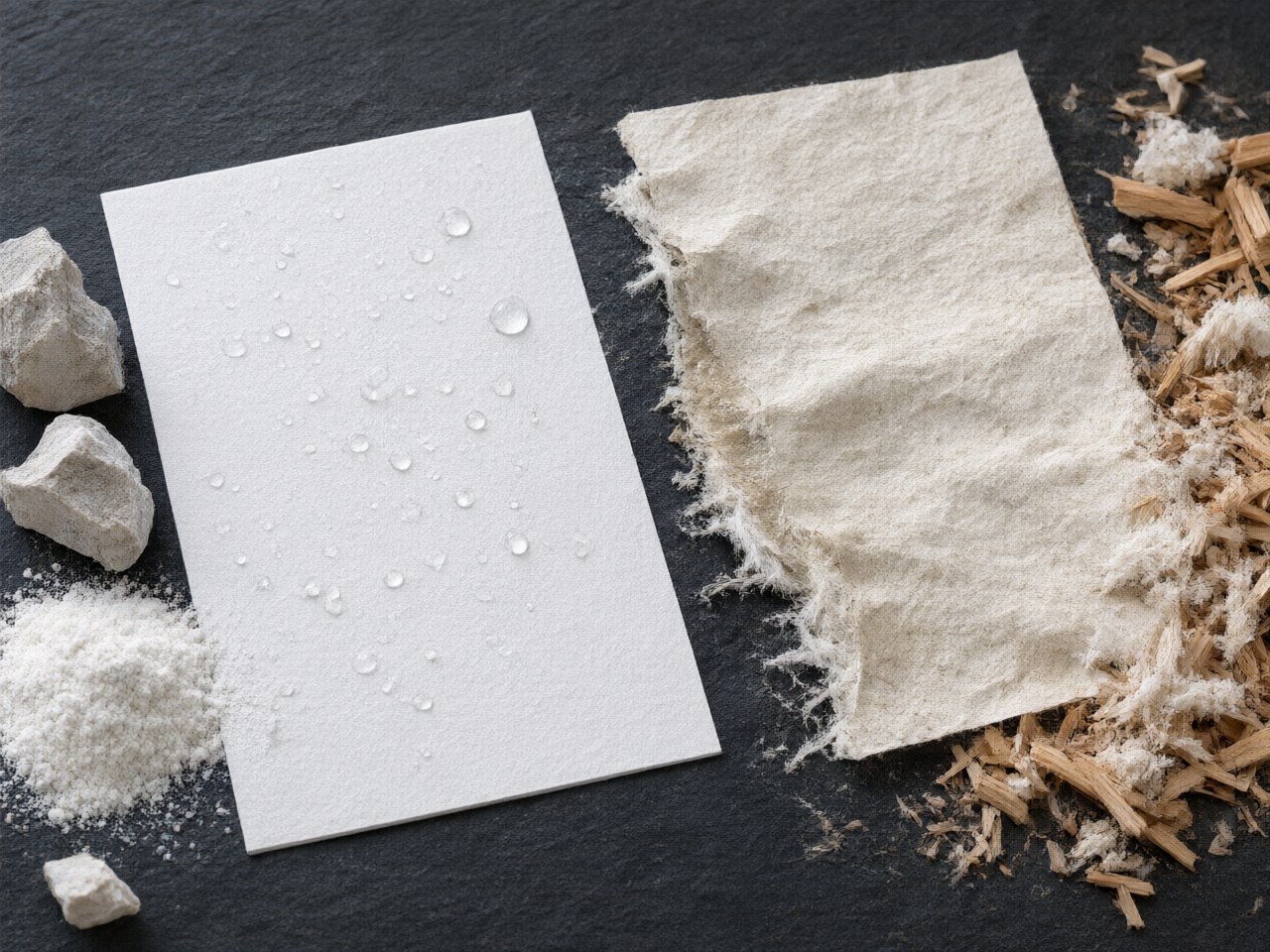
Flexstone is a composite of 60–80% calcium carbonate and 20–40% resin, in published density series of 1.0, 1.2 and 1.4 g/cm³. It is a mineral-filled sheet for the print and finishing jobs its specification covers. It is not a universal replacement for PVC or PET. Side-by-side parameters are on the material comparison page.
- Long-term outdoor graphics. Outdoor durability is below PVC. Do not specify it for permanent exterior signage. No weatherability or UV-resistance claim is published. - Fire-rated work. A project with a strict fire classification still needs flame-retardant PVC. No fire-rating claim is made for catalogue Flexstone. - Clear film. Catalogue grades are warm white and opaque. They cannot replace transparent film. - Retort and similar heat. The sheet contains thermoplastic resin and is not for high-temperature retorting or other extreme heat. PET remains the material for those jobs. Absence of an S-coating temperature ceiling is not permission to run retort conditions. - Mass versus PP pearl film. Flexstone is denser than PP pearl synthetic film, so the same area weighs more — the FG series most of all inside this comparison. - End of life. No biodegradable or compostable claim is made for Flexstone. Documented routes are regrinding into new material (post-consumer collection depends on local sorting and recyclers) and energy recovery. Newlife’s published product data, which is not a third-party life-cycle assessment, must be quoted against its own baseline: versus coated art paper, 20–35 tonnes of water and 20 trees saved per tonne; versus BOPP pearl synthetic paper, 500–650 kg less plastic and 2.4–3.5 tonnes less CO₂ per tonne. Do not merge those baselines into one percentage.
A specification sheet and a test print are the purchasing checks
Manufacturer facts in this article are density series, the S-coating process list, S-coating gloss of 3–8°, the published basis weights and tolerances for these five grades, the approximate non-adhesive basis-weight relationship, roll-supply listings, and the temperature figures for the two groups named above. Calculated roll masses are arithmetic from the published nominal basis weights and the listed 50 m length, not measured roll weights. Anything the documents do not cover — heater setpoint, ink loading, a named ink brand, lamination, cutting, mounting, and a thickness step the table does not list — stays off the purchase order. Heater, ink and finishing checks are sample-test items, written down before the run.
Per-model sheets for the NMEQS-MACO 293–299 and 303 set are requested from downloads, alongside the inkjet media series. Do not assign an S-coating grade to a sheet number that the sheet itself does not show.
Questions to settle before ordering S-coating rolls
Can an eco-solvent printer run FG-S32 without head strikes or buckling? No published figure answers that per machine. Of these five grades, FG-S32 has the highest published basis weight (440±44 g/m² at 0.32 mm and 1.4 g/cm³; FS-S32 is the same thickness at a lower basis weight), so it is the hardest load on the feed and the heater path. Test at production ink coverage, not at a light proof setting.
Is FG just a heavier FS? No. The S-coating process list is the same mapping; the base density is not. FS is 1.0 g/cm³ and FG is 1.4 g/cm³. FS-S32 and FG-S22 sit 20 g/m² apart on the published nominal (320±32 versus 300±30 g/m²) and are still a thick paper-like sheet versus a thinner stiff sheet. FG-S27 does not have a published FS twin in this set.
Does the S series have a published temperature limit? No. Long-term and short-term figures are published only for FS/FG 2K at 0.15–0.30 mm (NMEQS-MACO 293) and for the FG digital-press specifications (NMEQS-MACO 298). For FS-S and FG-S, test before any heated process, and do not call a use-environment range of −20°C to 60°C a dryer setting. Working and storage temperatures are likewise not a coating-wide band: read the clause on the sheet for the model ordered, and do not merge neighbouring grades into one interval.
Why is FS-S22-PSA the wrong roll for a weak-solvent printer? Because FS-S22-PSA is annotated for HP Latex only. A shared thickness code with non-adhesive FS-S22 does not make it a (weak) solvent grade. A K-PSA roll under NMEQS-MACO 294 is the wrong substitute as well: those K-PSA grades are wide-format UV inkjet, not (weak) solvent. Other PSA constructions on the Latex-only sheet have to be read from that sheet, not inferred from the non-adhesive S-coating list.
Send the press profile and ask the Flexstone team for a sample and the specification sheet
A short brief is enough for the Flexstone application engineering team to match a sample and the specification sheet to the model number. Include:
- printer model and ink type — (weak) solvent / eco-solvent, not a generic “solvent” label - roll width you actually run (1270, 1370 or 1524 mm, or another width only if that model’s sheet lists it), or sheet size if you sheet the rolls - thickness and density series under consideration (FS-S or FG-S, and a numeric suffix that the specification table actually lists) - whether the job needs a self-adhesive construction, and the surface it must stick to - end-use environment and the service life required, including any outdoor exposure or fire classification
With that, the team can supply a sample in the matched grade and the specification sheet for that model number, plus the short list of on-press checks above. Contact the Flexstone team for samples and specification sheets at the contact page. Run FS-S against FG-S on your own machine before you buy a production roll.
References
1. Flexstone inkjet media series (S-coating wide-format grades). https://www.stonepapers.net/en/products/inkjet-media 2. Specification downloads, NMEQS-MACO 293–299 and 303. https://www.stonepapers.net/en/downloads 3. Self-adhesive inkjet constructions. https://www.stonepapers.net/en/products/self-adhesive-inkjet 4. Printing on stone paper (wide-format inkjet process mapping). https://www.stonepapers.net/en/knowledge-base/printing-on-stone-paper 5. Stone paper fundamentals (composition, density series, non-adhesive basis-weight relationship). https://www.stonepapers.net/en/knowledge-base/stone-paper-fundamentals 6. Sustainability and end of life (manufacturer product data and documented routes; not a third-party LCA). https://www.stonepapers.net/en/knowledge-base/sustainability-and-end-of-life 7. Material comparison. https://www.stonepapers.net/en/compare