
Flexstone Calcium Carbonate Compound Pellets for Molding and Extrusion
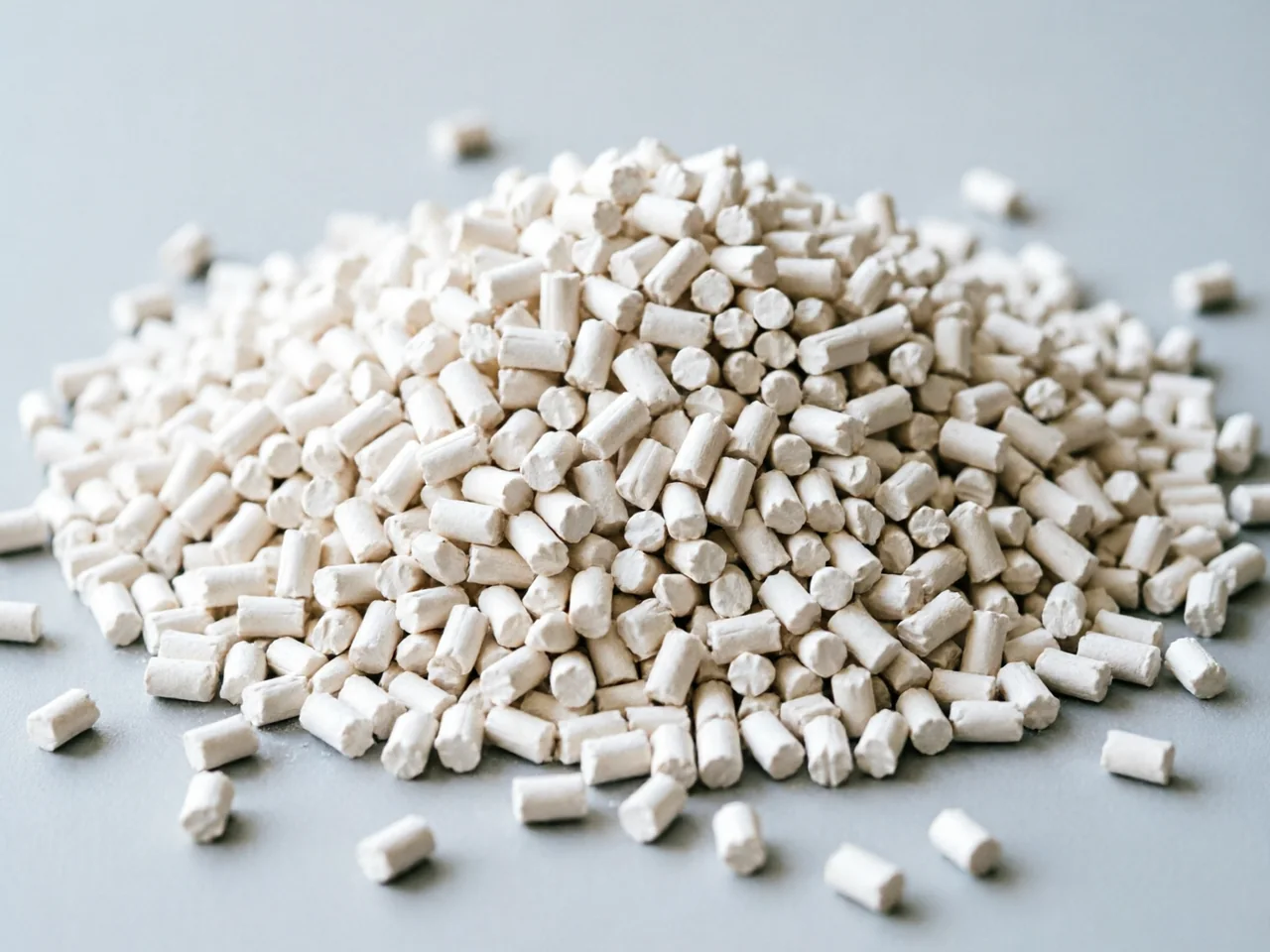
A new-generation eco-friendly material pellet that serves as a sustainable alternative to conventional petroleum-based plastics. It runs on existing injection molding, blow molding, extrusion and thermoforming equipment. Two series are offered: the PP series for rigidity, dimensional stability and heat resistance, and the PE series for flexibility, impact resistance and low-temperature performance. Density is about 1.5 g/cm³.
How this series is built
Flexstone Pellet is made primarily from calcium carbonate (limestone) compounded with polyolefin-based thermoplastic resin, with inorganic content exceeding 60%. Unlike conventional filled pellets, where calcium carbonate is an additive, limestone is the primary material. An optimised formulation keeps mechanical performance and melt strength stable at this high filler content.
Key features
- Inorganic (calcium carbonate) content above 60%
- PP series: flexural modulus ≥20 MPa, MI 2–3 g/10 min
- PE series: flexural modulus ≥10 MPa, MI 5–8 g/10 min
- Density about 1.5 g/cm³; surface adjustable from smooth to paper-like texture
Advantages
- Stable melt flow for uniform wall thickness in injection, blow and extrusion processes
- Mechanically recyclable as a single material; scrap and trim can be re-pelletized
- Stable limestone supply with minimal price fluctuation
What it means for you
- About 28% less petroleum-derived plastic and about 10% lower greenhouse gas emissions
- Green product upgrade without changing existing production processes
Runs on existing plastics equipment
- Injection moldingToys, crafts, daily goods.
- Blow moldingPackaging bottles, hollow products.
- ExtrusionSheets, pipes, profiles.
- ThermoformingTrays and packaging containers.
Source: Flexstone Eco-Material flyer. Bar widths use the mid-point of each range and are illustrative.
Flexstone® Pellet — part numbers and physical data
Values are reproduced from the Flexstone Pellet product brief in their original format. Select a series for its data page.
← Scroll horizontally to view all columns →
| Series | Density | Resin matrix | Flexural modulus | Melt flow index | Processing |
|---|---|---|---|---|---|
| Flexstone Pellet PP Series | about 1.5 | PP (polypropylene) | ≥20 MPa | 2–3 g/10min | Injection molding; Blow molding; Extrusion; Thermoforming |
| Flexstone Pellet PE Series | about 1.5 | PE (polyethylene) | ≥10 MPa | 5–8 g/10min | Injection molding; Blow molding; Extrusion; Thermoforming |
Typical uses
- Toys and art & craft products (injection molding)
- Packaging bottles and hollow products (blow molding)
- Sheets, pipes and profiles (extrusion)
- Food trays and packaging containers (thermoforming)
Processing compatibility
- Injection molding — excellent compatibility: toys, crafts, daily goods.
- Blow molding — excellent compatibility: packaging bottles, hollow products.
- Extrusion — excellent compatibility: sheets, pipes, profiles.
- Thermoforming — excellent compatibility: food trays, packaging containers.
- Density is higher than pure PP/PE (approx. 0.9–0.96 g/cm³); where lightweighting matters, optimise wall thickness in the part design.
Flexstone® Pellet — frequently asked questions
Q1What is Flexstone® Pellet?
Flexstone® Pellet is a material pellet made primarily from calcium carbonate (limestone) compounded with polyolefin-based thermoplastic resin, with inorganic content exceeding 60%. Unlike conventional filled pellets, where calcium carbonate is an additive, limestone is the primary material. It is positioned as an alternative to conventional petroleum-based plastics for toys, packaging containers, art and craft products and daily consumer goods.
Q2What is the difference between the PP series and the PE series of Flexstone® Pellet?
The PP series uses polypropylene as the resin matrix: flexural modulus ≥20 MPa, melt flow index 2–3 g/10 min, with higher rigidity, dimensional stability and good heat resistance. The PE series uses polyethylene: flexural modulus ≥10 MPa, melt flow index 5–8 g/10 min, with good flexibility, high impact resistance and excellent low-temperature performance. PP is recommended for toys, crafts and rigid bottles; PE for flexible bottles.
Q3Can Flexstone® Pellet be processed on existing plastic equipment?
Yes. According to the Flexstone Pellet product brief, it is compatible with injection molding, blow molding, extrusion and thermoforming and can be processed directly on existing equipment. Typical products are toys, crafts and daily goods (injection), packaging bottles and hollow products (blow molding), sheets, pipes and profiles (extrusion), and trays and packaging containers (thermoforming). Stable melt flow supports uniform wall thickness.
Q4What are the environmental figures and the density of Flexstone® Pellet?
According to the Flexstone Pellet product brief, the material reduces petroleum-derived plastic use by approximately 28% and greenhouse gas emissions by approximately 10%. Products can be mechanically recycled as a single material, and scrap and trim can be re-pelletized. Density is about 1.5 g/cm³, higher than pure PP or PE at about 0.9–0.96 g/cm³, so parts feel heavier; where lightweighting matters, optimise the wall thickness.
Request Flexstone® Pellet samples
Share your printer or converting line and target specification — we will match a grade and ship samples.