Republished by Newlife - Flexstone. All rights belong to the original publisher; see Source below.
Study Finds Recycled Film Viable for Non-Food Uses
A new study of curbside-collected multilayer flexible film finds non-food-contact polyethylene recyclable at commercial scale, while food-contact material needs further development.
Food-contact film faces steeper contamination challenges, but injection molding offers a workable path for all recycled streams.
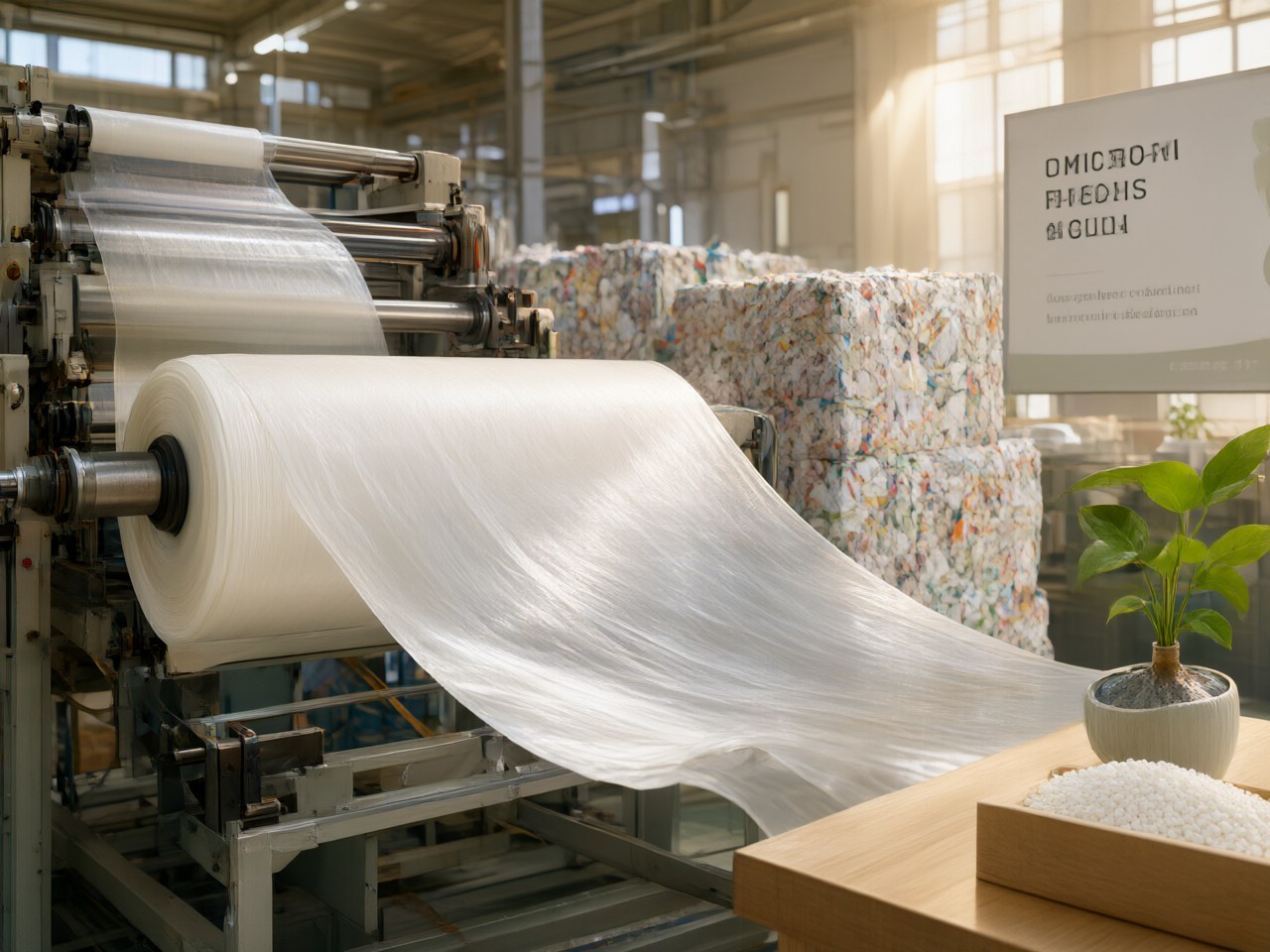
Non-food-contact polyethylene film collected through a residential subscription program can be mechanically recycled into stable blown film at concentrations of up to 50%, according to a new material analysis — a finding that researchers say offers one of the clearest paths yet toward circularity for post-consumer multilayer flexible packaging.
The study, conducted by Plastics Forming Enterprises (PFE) on behalf of the Flexible Film Recycling Alliance (FFRA) and Ridwell, evaluated the recyclability of multilayer flexible film collected through Ridwell's residential collection program, which gives consumers an alternative recovery pathway for packaging that is often excluded from traditional curbside recycling. The research examined the full life cycle of the material — from collection and sorting through reprocessing and end-use performance testing — and sorted it into food-contact and non-food-contact streams to understand how each performs in real-world recycling systems.
"The results detailed in this report demonstrate that recycling pathways for post-consumer multilayer flexible films are technically feasible and that viable end-market opportunities exist for film-derived recycled materials," according to the report.
Sorting the bale
Researchers began by verifying that the incoming bale consisted primarily of polyethylene (PE) film, removing contaminants such as wood, fiber, metal, polyethylene terephthalate (PET), polypropylene (PP), and heavily soiled film. They also excluded flexible films with paper labels, "clear crinkle" materials believed to be primarily polypropylene-based, and films with visible metalized layers, though metalized materials later underwent additional screening to identify structures that could be safely returned to the recycling stream.
Materials that had been in direct contact with food — including pet food packaging — were classified as food-contact, while everything else was classified as non-food-contact. After sortation, food-contact materials made up about 23% of the recovered PE film stream and achieved an 80% yield. Non-food-contact materials made up about 77% of the stream and achieved a 90% yield, according to the report.
Researchers also created an "industry blend" using unwashed pelletized material, combining 77% non-food-contact resin with 23% food-contact resin to mirror the overall composition of the incoming bale. The blend was designed, the report says, "to simulate a commercially realistic mixed-film recycling stream, where food-contact and non-food-contact PE films are recycled together, contaminants are removed, and the remaining material is processed as a single feedstock."
Washing made a difference
Each stream — food-contact and non-food-contact — was split further into washed and unwashed batches, producing four distinct recycled material streams for testing. The washing process relied solely on gentle agitation, with no added chemicals or heat, modeled after the RecyClass film washing methodology.
Evaluating washed against unwashed material mattered because curbside-collected film can carry more variable and heavier contamination than material dropped off at retail stores specifically because it is clean and dry. Understanding how washing affects performance, the report notes, is "vital to lab studies when evaluating commercial recycling pathways for post-consumer flexible films."
Extrusion exposed a pressure problem
During extrusion, PFE used a standard polyethylene film screen pack of 20/40/150/40/20 mesh screens to process all four material categories at 100% concentration. Only the washed and unwashed non-food-contact materials pelletized successfully under that configuration. Both food-contact streams triggered the extruder's high-pressure shutdown system — a safety mechanism that activates once melt pressure exceeds 3,000 psi — before pellets could be produced.
To get food-contact material through the line, researchers reduced filtration resistance step by step. An intermediate 40/60/40 screen pack still caused both washed and unwashed food-contact streams to trip the shutdown. Only after switching to a coarser 20/40/20 configuration did both food-contact streams pelletize successfully.
That fix came with a trade-off. "While the reduced filtration configuration enabled pellet production, it also increased the likelihood that contaminants such as food residues, particulate matter, gels, and higher-melting multilayer materials would pass through the extrusion process and remain in the recycled pellets," the report states, adding that those contaminants "have the potential to negatively affect downstream conversion operations, particularly processes requiring consistent melt quality and homogeneity, such as blown film extrusion and injection molding."
Blown film trials favored non-food-contact resin
Once pelletized, each material category was tested in blown film trials against a virgin polyethylene control resin, with researchers trying to determine the highest post-consumer recycled (PCR) content that could be processed while still holding a stable bubble.
At an initial trial of 50% PCR content, only washed non-food-contact material produced a stable bubble and acceptable film; every other stream failed. At 25% PCR content, both washed and unwashed non-food-contact materials succeeded, but neither food-contact stream could hold a stable bubble. Researchers then dropped food-contact material down to just 10% PCR content, and it still failed, a result the report attributes to the extra contamination allowed through by the coarser filtration needed to pelletize that stream in the first place.
An industry blend combining unwashed food-contact and non-food-contact pellets, in the same 23%-to-77% ratio identified during bale sortation, was also evaluated in both blown film and injection molding applications.
Injection molding worked for everything
If blown film highlighted the limits of food-contact recycled resin, injection molding highlighted its promise. All four material streams, plus the industry blend, were successfully molded into test specimens at 100% recycled content and evaluated for tensile strength, flexural performance, and Izod impact resistance.
"Injection molding proved to be the most promising end-market for all recycled material streams," according to the report. Testing showed the recycled resins held onto their tensile and flexural performance, and the industry blend "exhibited particularly strong impact performance with no break observed during Izod testing," the report says.
What it means for the industry
The study's conclusions draw a clear line between what recycled multilayer film can do today and what still needs work. Non-food-contact PE emerged as the stronger near-term opportunity, especially when washed first. "The non-food-contact stream achieved a 90.6% yield during sortation and was successfully pelletized using standard film recycling filtration systems," the report states, pointing to applications such as shipping sacks, industrial liners, construction film, and agricultural film as realistic next steps for that material.
Food-contact film tells a tougher story. Even though it made up only about 23% of the recovered bale, its higher contamination levels and metalized structures forced processors to loosen filtration just to get it through the extruder — and that compromise carried straight through to blown film performance. "These findings suggest that food-contact-derived multilayer films are not currently well-suited for film-to-film recycling pathways without additional cleaning, sorting, or advanced recycling technologies," the report concludes. Instead, the authors suggest this material is "better suited for more contamination-tolerant applications where film quality and melt homogeneity are less critical."
That is where injection molding comes in. Because molded parts proved far more forgiving of contamination than blown film, the report points to durable goods — pallets, totes, storage containers, landscaping products, automotive dunnage, and protective packaging components — as realistic homes for recycled multilayer film, including streams that could not survive the blown film process.
For an industry still working out how to handle flexible packaging at scale, the study offers a practical roadmap: wash and sort well, and non-food-contact film can go right back into film production; when the material is more contaminated or food-contact in origin, send it toward molded, durable products instead. Either way, the report's broader finding — that multilayer flexible film recycling is "technically feasible" with "viable end-market opportunities" — gives the Flexible Film Recycling Alliance, Ridwell, and the wider recycling community a data-backed case for continued investment in collection and processing infrastructure.
Source
- Plastics Today (2026-10-30) - Original article: Study Finds Recycled Film Viable for Non-Food Uses - https://www.plasticstoday.com/sustainability/study-finds-recycled-film-viable-for-non-food-uses