What to Watch Out for When Offset Printing on Stone Paper:
Ink Choice, Drying and Stack Height
Watch the specification, the ink route that specification actually lists, and pile height. Sheetfed offset on Flexstone® stone paper is a published route on 2K specifications, and is also listed on FG digital press specifications, which are not a substitute for that sheetfed 2K choice; the process list still changes with the data sheet and the thickness. No drying time and no maximum pile height are published, so those two settings belong to a press trial, not to the catalogue. Catalogue grades are warm white and opaque; outdoor durability is below PVC; the sheet is not for retort, a strict fire rating, or a biodegradable or compostable claim.
Published figures below are Flexstone® product data from Guangzhou Newlife New Material Co., Ltd. (Newlife). Where a figure is a recommendation, it is engineering practice and still has to be confirmed on your press with your ink.
The short answer:
sheetfed offset stays inside the 2K listings, and the listing still depends on the specification
For a sheetfed offset press, start with a 2K specification that lists offset. Do not treat density series, an S coating, or a wide-format K roll as an offset grade.
On the FS / FG 2K 0.15–0.30 mm specifications (data sheet NMEQS-MACO 293, Rev. A0) the listed processes are offset and UV-curable ink, plus flexo and screen. Here "UV" means UV-curable ink on a printing press, not a wide-format UV inkjet printer. That group is not compatible with HP Indigo, and dry-toner equipment must be tested before use; a passed test is not a published listing. The same 0.20–0.30 mm specifications are also sold as rolls on NMEQS-MACO 296 for wide-format UV inkjet. That roll listing is not a sheetfed offset route.
FM-2K and all 0.35 mm 2K specifications appear only in the Flexstone® brochure. They list offset and UV only, and they publish nominal grammage only.
Two other offset listings are easy to mix in, and they are not substitutes for that sheetfed 2K choice. Narrow-web K label facestock (NMEQS-MACO 295) lists offset, flexo and UV on label presses; it is not a wide-format inkjet medium and not a sheetfed commercial grade. FG digital press specifications (NMEQS-MACO 298) list offset among other processes, but they are the HP Indigo and dry-toner family. S-coated media do not publish a sheetfed offset route.
The first decision is not which density series feels right. It is whether the sheet in front of you is the specification that publishes the process your press actually runs.
Work through specification, opacity, ink and pile in that order
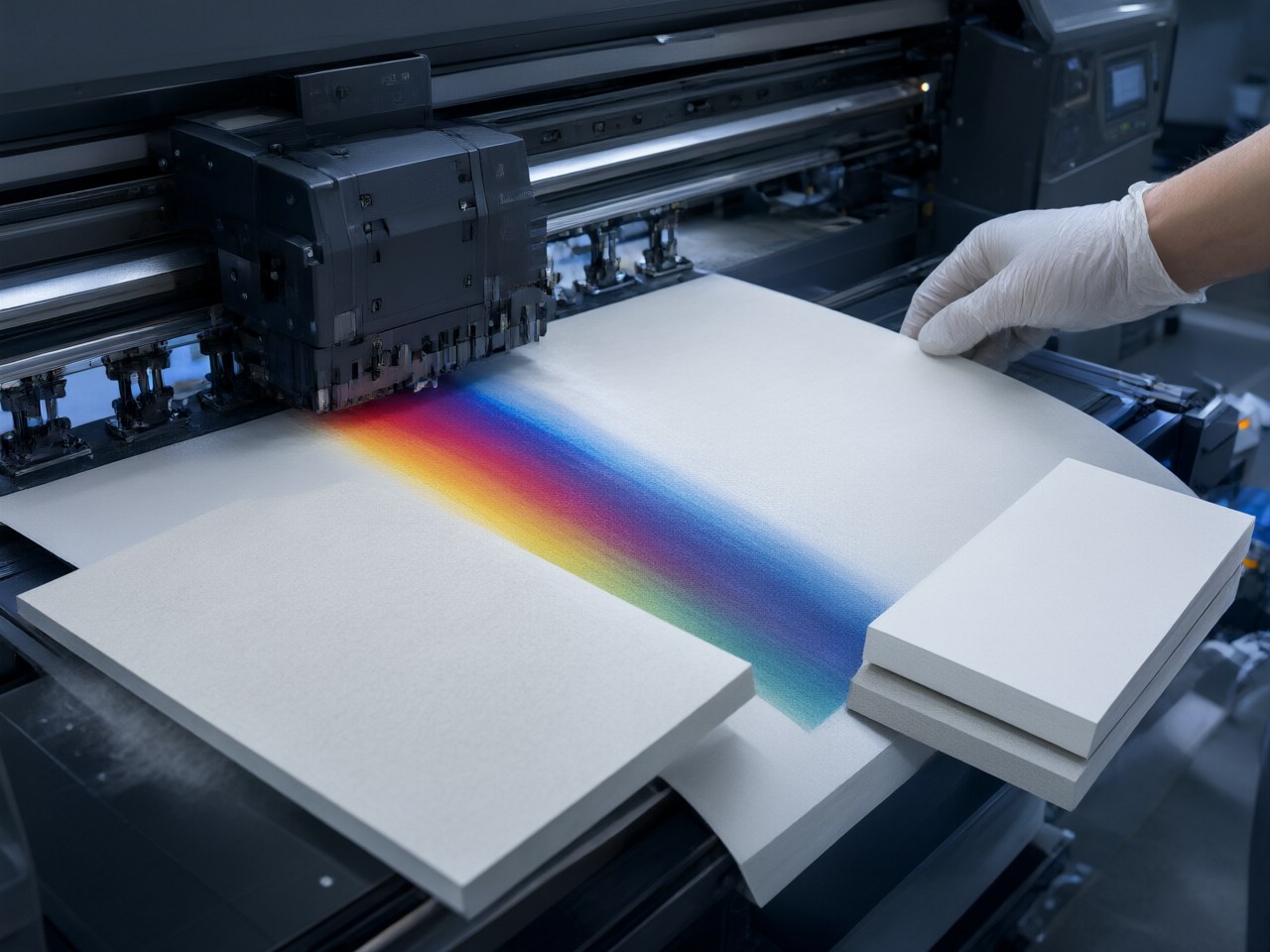
Use a double-sided, four-colour insert on a sheetfed press that is already running conventional offset ink and has no UV curing unit. No customer, run length or press result is being reported; the sequence is the point.
First, place the sheet in a group that publishes offset for this press: a 2K specification. If the job needs the published optical and heat figures, that is the FS / FG 2K 0.15–0.30 mm group on NMEQS-MACO 293, not a brochure-only FM-2K or 0.35 mm sheet.
Second, check opacity by specification, not by density series. On NMEQS-MACO 293, FG-2K15 is ≥85%, FS-2K20–30 is ≥95%, and the other specifications in that 0.15–0.30 mm group are ≥90%. Narrow-web K facestock (NMEQS-MACO 295) and the FG digital press specifications (NMEQS-MACO 298) are ≥90%. The data sheets do not define a show-through pass/fail for double-sided print, so the trial still has to show whether the published figure is enough for the artwork. A stiffer FG sheet is not an opacity upgrade.
Third, ask the ink question in the terms the data sheet uses. Offset and UV-curable ink are both listed on NMEQS-MACO 293, so this press does not have to be a UV press. Drying time is not published.
Fourth, set the drying trial and the pile height together. Set-off in the delivery is the failure a taller pile makes worse, and no maximum pile height is published.
If the same artwork arrived as a dry-toner job, the matching products are the FG digital press specifications on NMEQS-MACO 298 — FG-2I, FG-I15-PSA and FG-I20-PSA — which list dry toner, UV-curable ink, offset and screen. Their short-term heat figure is 120 °C for minutes, not a continuous rating and not a Flexstone-wide rating. FS-2I and FM-2I are not that family.
Offset routes in the Flexstone® range, by specification
Offset is published for more than one specification, and the limits are not interchangeable. Read the row for the sheet you will buy.
| Model group / specification | Published process | Offset-relevant limits | Opacity (published) | Published heat data | Source |
|---|---|---|---|---|---|
| FS / FG 2K, 0.15–0.30 mm | Offset and UV-curable ink; also flexo and screen | Not compatible with HP Indigo; dry toner must be tested. UV here is press-curable ink, not wide-format UV inkjet | FG-2K15 ≥85%; FS-2K20–30 ≥95%; other specifications on this sheet ≥90% | Long-term (days) 80 °C; short-term (minutes) FS 100 °C, FG 120 °C | NMEQS-MACO 293 (Rev. A0) |
| FS / FG 2K, 0.20–0.30 mm, roll | Wide-format UV inkjet | Roll stock, not a sheetfed offset route | FS-2K20–30 ≥95%; FG-2K20–30 ≥90% | No separate rating. Same 0.15–0.30 mm specification envelope as NMEQS-MACO 293 | Process: NMEQS-MACO 296 (Rev. A0); heat: NMEQS-MACO 293 |
| FM-2K; all 0.35 mm 2K | Offset and UV only | Brochure only; nominal grammage only | Not published | Not published. Not for retort; test before any heating process | Flexstone® brochure |
| K narrow-web label facestock | Offset, flexo and UV on label presses | Not a wide-format inkjet medium and not a sheetfed commercial grade | ≥90% | Not published. Do not borrow the 293 or 298 heat figures | NMEQS-MACO 295 (Rev. A0) |
| FG digital press specifications (FG-2I, FG-I15-PSA, FG-I20-PSA) | HP Indigo; also dry toner, UV-curable ink, offset and screen | Sheet sizes 460 × 320 mm and 480 × 330 mm. Not a substitute for a 2K sheetfed grade | ≥90% | Long-term (days) 80 °C; short-term (minutes) 120 °C | NMEQS-MACO 298 (Rev. A0) |
| FS-2I, FM-2I | HP Indigo only | Brochure only; nominal grammage only. Do not apply NMEQS-MACO 298 optical, heat or sheet-size data | Not published | Not published | Flexstone® brochure |
Gloss on the FS / FG 2K 0.15–0.30 mm specifications is published as 4–6° / 9–12°, by specification within that group. Whiteness for data-sheet specifications is ≥82. Neither figure is a drying-time predictor. Drying time is not published. Brochure-only grades do not carry these optical figures.
Pile load at a given height follows from published density, not from a paper habit
At equal pile height, delivery load scales with the published density series. No maximum pile height is published. The two relationships below are arithmetic from that published density, not fitted press coefficients and not measured pile trials.
Nominal grammage. For non-adhesive specifications, nominal grammage (g/m²) ≈ thickness (mm) × density (g/cm³) × 1000. Series densities are FS = 1.0, FM = 1.2 and FG = 1.4. A 0.20 mm non-adhesive FS sheet has nominal grammage ≈ 200 g/m²; the same caliper in FG is ≈ 280 g/m². At the same caliper, FG therefore carries more mass per square metre. Do not apply this product to adhesive constructions: total thickness is published by model and is not the face caliper alone.
Solid-stack pile load. For a non-adhesive stack with no air gap, load (kg per m² of footprint) = pile height (mm) × density (g/cm³). The unit identity is: 1 mm over 1 m² is 1,000 cm³, and 1,000 cm³ at 1 g/cm³ is 1 kg. A 150 mm solid stack — an arithmetic example, not a recommended or maximum pile height — is 150 kg/m² in FS, 180 kg/m² in FM and 210 kg/m² in FG. At equal height, FG is 40% heavier than FS. Real deliveries contain air between sheets, so a measured load sits below this ceiling. Use the ceiling to check delivery-board, jogger and pallet capacity. It is not a published pile limit, and it is not a comparison with wood-pulp paper.
Ink choice follows the published process list, then a press trial
Match the ink to the process list on that specification. An absorption rate and a drying time are not published.
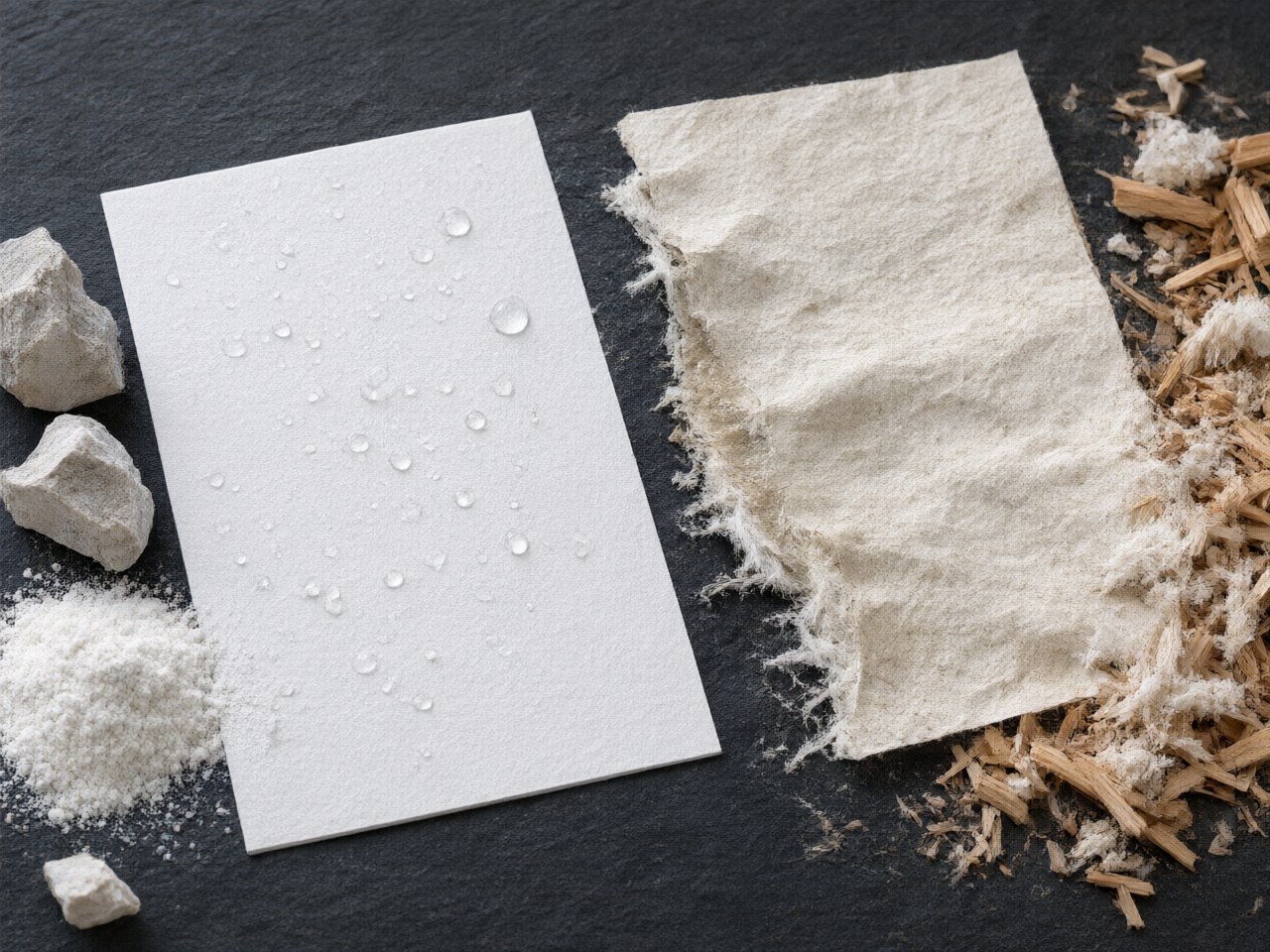
Flexstone® stone paper is a mineral-filled resin sheet. The published composition is calcium carbonate 60–80% and resin 20–40%. It is not a wood-pulp sheet. Do not copy a wood-pulp setting window, ink-film weight or anti-set-off recipe onto it, and do not treat "longer" or "lighter" as a published delta. Establish those settings on a trial for the route the specification lists.
On NMEQS-MACO 293, offset and UV-curable ink are both listed for the FS / FG 2K 0.15–0.30 mm group, together with flexo and screen. Listing both does not mean every ink brand behaves the same on every 2K sheet. Where the press has a UV curing unit, UV-curable ink is a published route for that group. Where the press has no curing unit, the published route is offset, and the setting behaviour still has to be trialled. Ink brand, fountain-solution ratio and varnish compatibility are not in the Flexstone® data sheets.
Trial method, not a published process window: print a solid, a mid-tone and a fine reversed line; stack the sheets; inspect for set-off after an interval you record; fold a sample and check for cracking; on double-sided work, check show-through. Record the interval. Do not report it as a Flexstone drying time.
Drying and pile height are one trial, not two published settings
Drying and pile height have to be set together, because neither a drying time nor a maximum pile height is published. No IR power setting is published either. Any specific number offered for those belongs to the printer's trial, not to the material.
Heat data are not a Flexstone-wide rating, and they are not a property of a density series or of "the 2K coating". They are published for two groups only:
- FS / FG 2K 0.15–0.30 mm: 80 °C long-term (days); short-term (minutes) 100 °C on FS and 120 °C on FG (NMEQS-MACO 293). - FG digital press specifications: 80 °C long-term (days) and 120 °C short-term (minutes) (NMEQS-MACO 298).
Every other specification, including FM-2K, 0.35 mm 2K and narrow-web K label facestock, has no published heat data. Do not write "rated to 120 °C" as a coating, series or Flexstone figure, and do not borrow the 80 / 100 / 120 °C figures for a specification that does not publish them.
If you assist drying with IR or hot air, design only against the envelope published for the specification on the press, and measure sheet surface temperature rather than the lamp setpoint. For specifications with no published heat data, test before any heating process. None of these ratings is approval for retort or other very-high-temperature work. The finished-piece service range below is not a drying limit either.
Press recommendation, to be verified on your equipment: start the trial at a pile height below the habit you use for wood-pulp paper, because set-off under the sheet's own weight is the risk and no pile limit is published; add interleaving or an intermediate board on long stacks; if you use spray powder on double-sided work, inspect the reverse, because powder carried onto the back then sits between the second-pass blanket and the coating. Static, guillotine cutting and folding are not listed. Check them on the same printed sample. A mineral-filled sheet can feed, cut and fold differently from wood-pulp paper.
Workshop, storage and service conditions apply only to data-sheet models
Workshop, storage and shelf-life conditions apply only to models listed on the Flexstone® data sheets. Brochure-only grades do not publish them. The service range of the finished piece is a separate figure, and it is not a process-temperature limit.
No shared workshop temperature and no shared storage temperature are published for Flexstone® as a whole, or for every data-sheet model together. NMEQS-MACO 293, 295, 296 and 298 each carry their own condition lines. Take workshop temperature, workshop humidity, storage temperature, storage humidity and shelf life from the data sheet of the specification on the press. Do not average those lines into one house range, and do not copy one sheet's line onto another specification.
The service environment of the finished piece is published as one range, and it is not those workshop or storage lines: −20 °C to 60 °C, 20–80% relative humidity, with a temperature change of less than 15 °C within 30 minutes. That is where the printed piece lives after it leaves the press. It is not the heat rating in the previous section, and it must not be used as a drying setpoint or as an IR limit.
Opened-material handling is specification-specific as well. Data sheets other than NMEQS-MACO 293 require unused material to be used within one month. Reseal the pack between withdrawals and follow the storage line on that sheet.
FM-2K, all 0.35 mm 2K specifications, FS-2I and FM-2I appear only in the brochure. Workshop, storage, shelf life and the one-month opened-material condition are not published for them. Do not borrow a data-sheet condition line for a brochure-only grade.
Stone paper is the wrong substrate when the job needs outdoor life, a fire rating, clarity or retort
Flexstone® is the wrong sheet when the job needs any of the following.
Long-term outdoor signage: outdoor durability is below PVC, so long-term outdoor signs are not recommended. Short-term outdoor posters are within scope. Do not describe the material as outdoor-durable, weatherable or UV-resistant.
A strict fire rating: those applications still need flame-retardant PVC. A halogen-free flame-retardant formulation is still in development and is not a current catalogue grade. Do not describe current catalogue grades as fireproof or flame-retardant.
A clear window: catalogue grades are warm white and opaque and cannot replace clear film. Do not describe a density series as high-opacity; opacity is published by specification, as in the table above.
Retort or other very-high-temperature processing: the material contains thermoplastic resin and is not suitable for retort or other very-high-temperature work. Those applications should still use PET. A short-term heat figure, where one exists, is not retort approval.
Very low mass at high caliper: the sheet is denser than PP pearl film and heavier per unit area. It is the wrong choice when the job needs the lowest mass at a given thickness.
A biodegradable, degradable or compostable claim: do not make one. The published end-of-life routes are pulverising for remanufacture, where post-consumer collection depends on the local sorting system and the recycler, and energy recovery. Neither route is biodegradation or composting.
Read the data sheet for the exact specification before you commit a run
Check the data-sheet number for the specification you will buy. A series-level summary hides the limits above.
Sheetfed offset and UV-curable routes are on the offset and UV media series page. Data sheets NMEQS-MACO 293, 295, 296 and 298 (Rev. A0) are available from specification downloads. Part-number logic is in the grade and part-number guide. Coating-to-process relationships are in printing on stone paper. Where the job sits between material families, use the material comparison page rather than a series adjective.
Keep the supply formats apart:
- Wide-format rolls are 50 m long, in widths 1270 / 1370 / 1524 mm. Those are wide-format roll formats, not sheetfed offset sheet sizes. - Narrow-web label facestock is slit at 210 / 310 / 410 / 510 mm. - FG digital press sheets are published at 460 × 320 mm and 480 × 330 mm only. - Other single sheets are cut to order. A 2K offset job is not limited to the FG digital sheet sizes.
Four questions offset printers ask before the first stone paper run
The recurring questions are which specification lists offset, whether a 2K sheet can go on an HP Indigo, how high the pile may be, and whether 0.35 mm is the same product as 0.30 mm.
Can I run the conventional offset ink already on my press? On specifications that list offset, that route is published — including the FS / FG 2K 0.15–0.30 mm group on NMEQS-MACO 293, where offset and UV-curable ink are separate listings. It is not a yes for S-coated inkjet media or for wide-format K rolls. Brochure-only 2K grades list offset and UV, but they publish nominal grammage only, so optical, heat and storage behaviour still have to be trialled. No drying time or anti-set-off recipe is published.
Can I put a 2K sheet on an HP Indigo? No. NMEQS-MACO 293 states that those 2K specifications are not compatible with HP Indigo. For HP Indigo, use I / 2I specifications. Optical data, heat data and the 460 × 320 mm and 480 × 330 mm sheet sizes belong only to the FG digital press specifications (FG-2I, FG-I15-PSA, FG-I20-PSA, NMEQS-MACO 298). FS-2I and FM-2I are brochure-only: HP Indigo, nominal grammage only. For dry-toner equipment, name those FG digital press specifications. Do not send dry toner to the NMEQS-MACO 293 group without a test.
How tall can I build the delivery pile? No pile height is published. Use the solid-stack calculation to see what the delivery is carrying, and start the trial lower than your wood-pulp habit. The 150 mm figure in that calculation is an example, not a limit.
Is a 0.35 mm 2K sheet the same product as a 0.30 mm 2K sheet? No. The 0.35 mm 2K specifications and all FM-2K specifications appear only in the Flexstone® brochure. They list offset and UV only and publish nominal grammage only — no optical data, no heat data, and no published workshop or storage conditions.
Send the press profile, then ask for a sample and the matching data sheet
A useful sample request states the press and ink system (conventional offset, UV-curable, HP Indigo or dry toner), the sheet size or web width, the thickness and density series (FS 1.0, FM 1.2, FG 1.4), whether the piece is single- or double-sided, whether it needs adhesive and the surface it will be applied to, and the service environment and required life.
Match that description to one specification before the run is scheduled. Contact the Newlife - Flexstone team for samples and the matching specification sheets: samples and specification sheets.
References
1. Guangzhou Newlife New Material Co., Ltd., Flexstone® data sheet NMEQS-MACO 293 (Rev. A0) — FS / FG 2K, 0.15–0.30 mm. 2. Guangzhou Newlife New Material Co., Ltd., Flexstone® data sheet NMEQS-MACO 296 (Rev. A0) — FS / FG 2K, 0.20–0.30 mm, roll form, wide-format UV inkjet. 3. Guangzhou Newlife New Material Co., Ltd., Flexstone® data sheet NMEQS-MACO 295 (Rev. A0) — narrow-web label facestock. 4. Guangzhou Newlife New Material Co., Ltd., Flexstone® data sheet NMEQS-MACO 298 (Rev. A0) — FG digital press specifications. 5. Guangzhou Newlife New Material Co., Ltd., Flexstone® brochure — FM-2K, 0.35 mm 2K, FS-2I and FM-2I; nominal grammage only. 6. Newlife - Flexstone, "Printing on Stone Paper," https://www.stonepapers.net/en/knowledge-base/printing-on-stone-paper 7. Newlife - Flexstone, "Offset and UV media," https://www.stonepapers.net/en/products/offset-uv-media 8. Newlife - Flexstone, "Specification downloads," https://www.stonepapers.net/en/downloads 9. Newlife - Flexstone, "Flexstone grades and part numbers," https://www.stonepapers.net/en/knowledge-base/flexstone-grades-part-numbers 10. Newlife - Flexstone, "Material comparison," https://www.stonepapers.net/en/compare