How to Choose Between PSA, WRA and DPA Adhesives? Permanent, Removable and Air-Release Use Cases
Choose PSA when the graphic or label must stay fixed on a smooth surface. Choose WRA when the graphic must come off later, including where the surface is semi-rough. Choose DPA when you install large removable graphics on smooth surfaces and need bubble-free application with clean removal indoors within 6 months.
All three Flexstone® adhesives share the same published holding-power result: a 25 × 25 mm area holds a 0.5 kg load for 24 hours without slipping. Because that holding-power result is the same in the published data, the choice depends on four other factors: whether the graphic must be removable, the surface texture, how the installer will handle large panels, and which print process the face coating supports.
PSA, WRA and DPA Compared Side by Side
The table below summarises published data from the Newlife specification sheets and the Flexstone website pages listed in the References.
| Criterion | PSA (permanent) | WRA (water-based removable) | DPA (dot-pattern air-release) |
|---|---|---|---|
| Bond type | Medium-tack permanent pressure-sensitive adhesive, carrier-free | Water-based removable adhesive, medium tack | Dot-coated high-adhesion acrylic removable adhesive, medium initial tack |
| Removal | Not removable once fixed | Removable; no removal time window published | Clean removal from smooth surfaces indoors within 6 months |
| Suitable surfaces | Most smooth surfaces | Semi-rough and smooth surfaces | Smooth surfaces |
| Installation behaviour | Bonds firmly after placement | No specific installation aid published | Repositionable during application; air channels between dots let trapped air escape |
| Holding power | 25 × 25 mm, 0.5 kg, 24 h, no slip | Same | Same |
| Where offered | Self-adhesive inkjet series (S-coated PSA parts; K-PSA rolls, NMEQS-MACO 294); label stock (NMEQS-MACO 295) | Self-adhesive inkjet series; label stock (NMEQS-MACO 295) | Eco-Film DPA air-release film, 5 part numbers (NMEQS-MACO 303) |
| Print process of listed face | K-PSA rolls (294): wide-format UV inkjet. S-PSA parts: eco-solvent (mild solvent), HP Latex, wide-format UV inkjet, except FS-S22-PSA and FS-S27-PSA, which are listed for HP Latex only. Label stock (295): offset, flexo and UV-curing inks on label presses | Follows the face coating of the specific part number. Check the spec sheet | K coating (303): wide-format UV inkjet |
Permanence Is the First Decision
Decide how long the graphic must stay in place before you look at any other property. That single answer usually eliminates one or two options.
PSA fits jobs where the graphic is meant to stay: product labels that should remain on the item, fixed interior signage, and panel graphics mounted once on smooth boards. It is a carrier-free, medium-tack permanent adhesive, with moderate initial tack and a firm bond once placed.
WRA and DPA both cover removable work, but they suit different situations. For a graphic that will be taken down, compare the two on surface and format, as described in the next two sections.
When the brief simply says “removable”, ask how long the graphic will stay up. DPA’s clean-removal statement covers smooth surfaces, indoors, within 6 months. Outside those three conditions there is no published data.
Surface Texture Decides Between WRA and DPA
For removable graphics, the surface is the deciding factor. DPA is specified for smooth surfaces. WRA is specified for semi-rough as well as smooth surfaces.
A dot-pattern adhesive touches the surface only at the dots. On glass, laminated boards, glossy painted metal or sealed display fixtures, that contact is enough, and the dots provide the air-release and repositioning behaviour. On a semi-rough substrate, such as some matte-painted walls, the published guidance points to WRA because it is rated for that texture.
Neither adhesive is listed for heavily textured surfaces such as raw brick, coarse plaster or deep-relief wallcoverings. If a job involves such a surface, treat it as untested. Apply a sample, leave it for the intended period under the real conditions, then peel it and check three things: residue on the surface, damage to paint or finish, and edge lift during the dwell period.
To grade a surface on site, run a fingertip and a raking light across it. If you can see or feel a regular texture, start sampling with WRA. If the surface is visibly smooth and the graphic is large, start with DPA.
Large-Format Installation Favours DPA's Air Channels
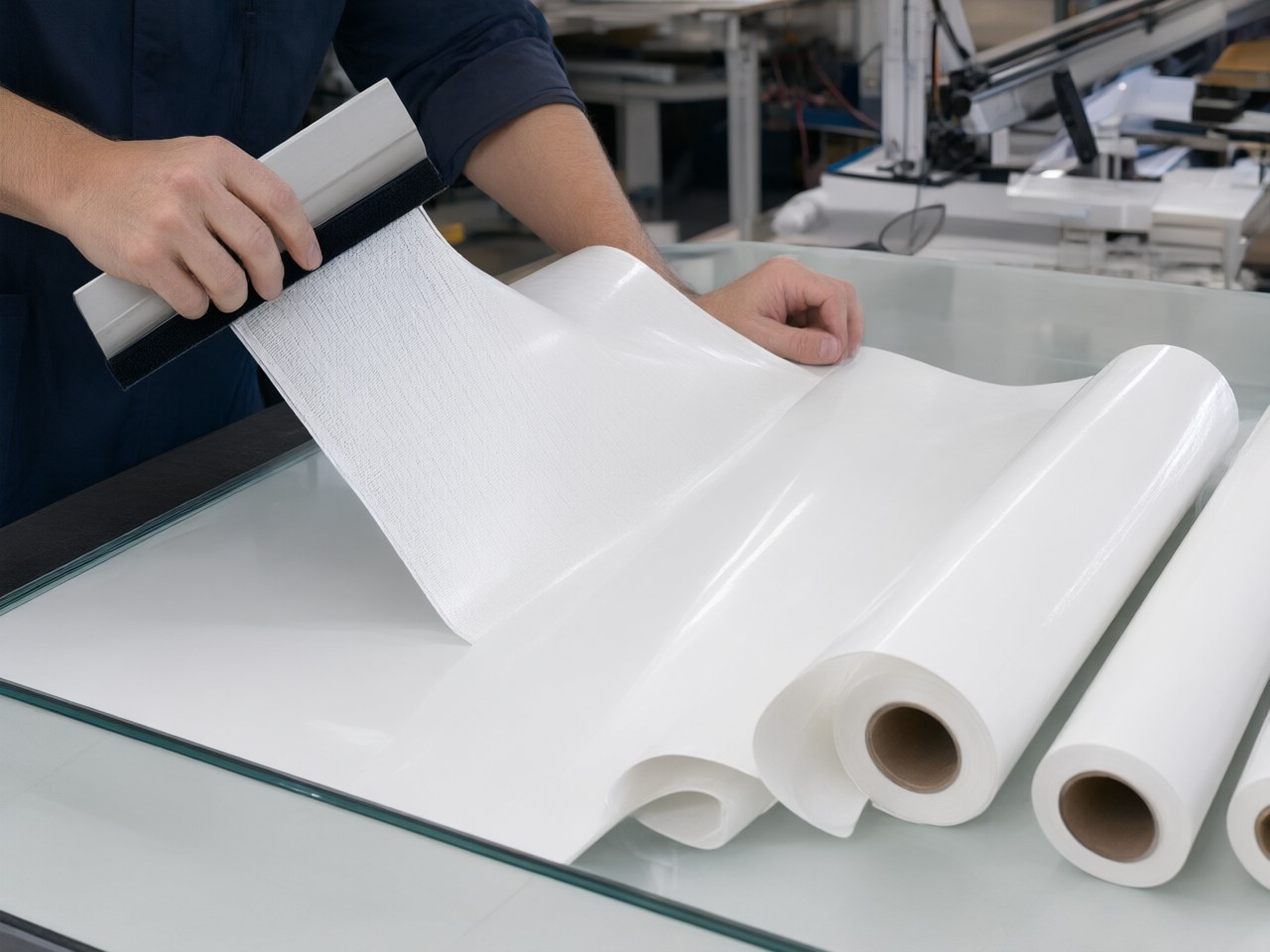
The dot coating leaves channels between the adhesive points. Air escapes through those channels as the panel is applied, so the graphic goes down without trapped bubbles. Medium initial tack lets the installer lift and reposition a panel during alignment, which matters when matching seams across several drops.
Installers working with PSA or WRA on large panels should allow more time for squeegee technique. Neither adhesive has a published air-release feature. Small formats such as labels, hang tags and short-run point-of-sale pieces rarely need air release, so PSA or WRA on label stock suits most of that work.
Print Process Narrows the Part Number
The adhesive choice and the print process are linked through the face coating. After choosing the adhesive, confirm that the part number’s coating matches the press.
- Wide-format UV inkjet: K-PSA rolls (NMEQS-MACO 294), K-coated DPA film (NMEQS-MACO 303), and S-coated PSA parts in the self-adhesive inkjet series. FS-S22-PSA and FS-S27-PSA are listed for HP Latex only. - Eco-solvent (mild solvent) or HP Latex: use S-coated PSA parts in the self-adhesive inkjet series. FS-S22-PSA and FS-S27-PSA are listed for HP Latex only. Confirm the printer type before choosing those two. - Label presses: narrow label stock (NMEQS-MACO 295) uses the K coating for offset, flexo and UV-curing inks on the press. - WRA parts: the print process follows the coating of the individual WRA part number. Read it from the relevant spec sheet on the downloads page.
Total thickness varies by construction, even at the same face thickness. A 0.15 mm face is 0.25 mm total on the wide-format K-PSA roll (NMEQS-MACO 294) and 0.23 mm total on the narrow label stock (NMEQS-MACO 295). Other face thicknesses have their own totals on the part-number spec sheet. Set die-cutting depth, feeder settings and applicator gaps from the total thickness on that sheet, not from the face thickness alone.
Supply Formats for Each Adhesive Route
Format often settles the choice once adhesive and coating are clear.
| Route | Format | Source |
|---|---|---|
| Wide-format self-adhesive inkjet (PSA, WRA) | 50 m rolls, widths 1270 / 1370 / 1524 mm; FS-K15-PSA-80G and FS-K20-PSA-80G at 1270 / 1370 mm | Self-adhesive inkjet series; NMEQS-MACO 294 for K-PSA rolls |
| DPA air-release film | Wide-format rolls, 5 part numbers; confirm length and width on the spec sheet | Eco-Film DPA series; NMEQS-MACO 303 |
| Narrow label stock (PSA, WRA) | Slit widths 210 / 310 / 410 / 510 mm | Label stock; NMEQS-MACO 295 |
Confirm width and length against the specific part-number spec sheet before ordering. The series pages for self-adhesive inkjet media, DPA air-release film and label stock list the current part numbers.
Working, Service and Storage Windows
Adhesive performance depends on handling conditions. Working environment, storage and shelf life are published only for the part numbers on a given specification sheet.
- Working environment during printing and application: take the temperature and relative humidity from the spec sheet that lists that part number — NMEQS-MACO 294 for K-PSA rolls, NMEQS-MACO 295 for label stock, NMEQS-MACO 303 for DPA film. - Service environment of the finished graphic: −20 °C to 60 °C, relative humidity 20–80%, with temperature changes under 15 °C within 30 minutes. This describes where the installed product lives. - Storage and shelf life: keep to the conditions stated for that part number on its own spec sheet. - Opened material: reseal partly used rolls and use them within 1 month. That limit is stated on the specification sheets other than NMEQS-MACO 293, including 294, 295 and 303.
Two practical points follow from these limits. First, condition both the material and the room to the working window on that part number’s spec sheet before printing or application. A cold wall in winter, or a surface warmed by sun-facing glass, can sit outside the window for that part, so tack and repositioning may not match the spec-sheet results. Second, the 1-month rule for opened stock affects removable jobs in particular. A half-used DPA or WRA roll kept for a reprint months later should be tested again before use.
Spec sheets report rolling-ball initial tack alongside holding power. The self-adhesive constructions knowledge-base article explains how to read the two together. Compare one part-number spec sheet with another under the same test method.
When Stone-Paper Adhesive Graphics Are the Wrong Choice
Some briefs need a different substrate, whichever adhesive is used.
- Long-term outdoor signage: Outdoor durability is lower than PVC. Short-term outdoor posters are within scope. Multi-year exterior graphics should be specified in PVC. - Strict fire-rating requirements: Projects that require certified fire performance still need flame-retardant PVC. - See-through applications: Catalogue part numbers are warm white and opaque. - High-heat environments: The material contains thermoplastic resin. Retort, steam sterilisation and similar very high-temperature uses call for PET. The adhesive constructions in this guide have no published heat-resistance data; test any heated converting step on a sample first. - Weight-sensitive builds: Flexstone is denser than PP pearlescent film and weighs more per unit area. Allow for this on large hung or ceiling-mounted panels.
Processes the spec sheets do not cover, such as over-laminating an adhesive graphic, hot-foil stamping or heat transfer, need a sample trial first. Check adhesion of the laminate to the print, curl after lamination, behaviour of the adhesive at the liner edge, and removal results after dwell.
Evidence You Can Check Before Committing
Construction, total thickness, holding power and initial tack cited above are published on documents the Flexstone application engineering team supplies on request. Spec sheets NMEQS-MACO 294 (K-PSA rolls), 295 (label stock) and 303 (DPA film), version A0, give those values for each listed part number. A practical trial order is:
1. Print the actual artwork on the production printer with the production ink set. 2. Apply the sample to the real surface, or an offcut of it, within the working window on that part number’s spec sheet. 3. Inspect it at intervals over the planned display period. 4. For WRA and DPA, peel at the end of the period and record residue and surface condition.
FAQ
Can DPA be used on a semi-rough painted wall?
Is WRA's removal window also 6 months? No removal time window has been published for WRA.
Does DPA hold less strongly than PSA because it is removable?
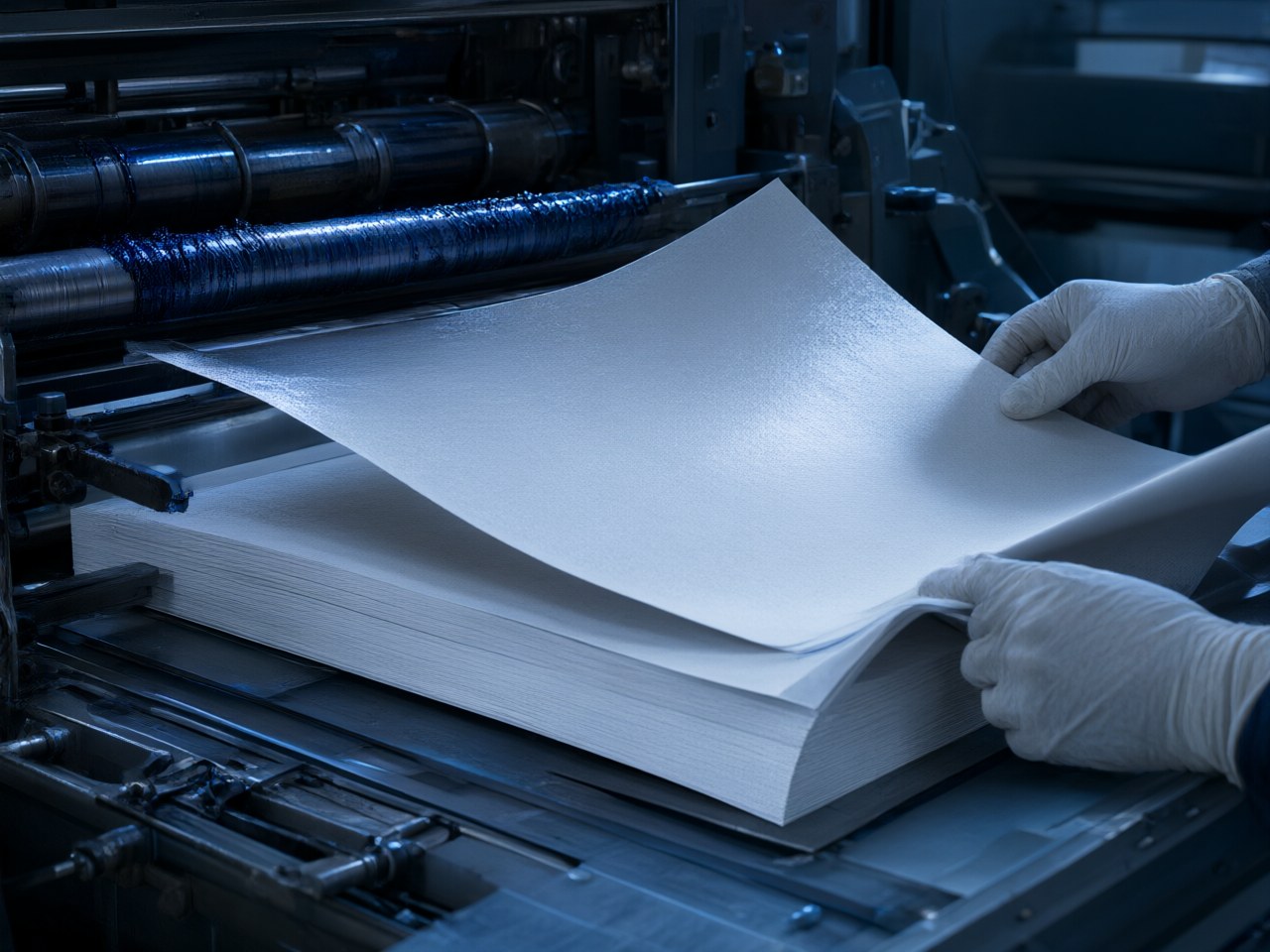
Which adhesive should I use for hang tags and product labels? Use label stock (NMEQS-MACO 295) with PSA for labels that must stay on, or with WRA for labels that must peel off. Related application notes are on the labels and hang tags page.
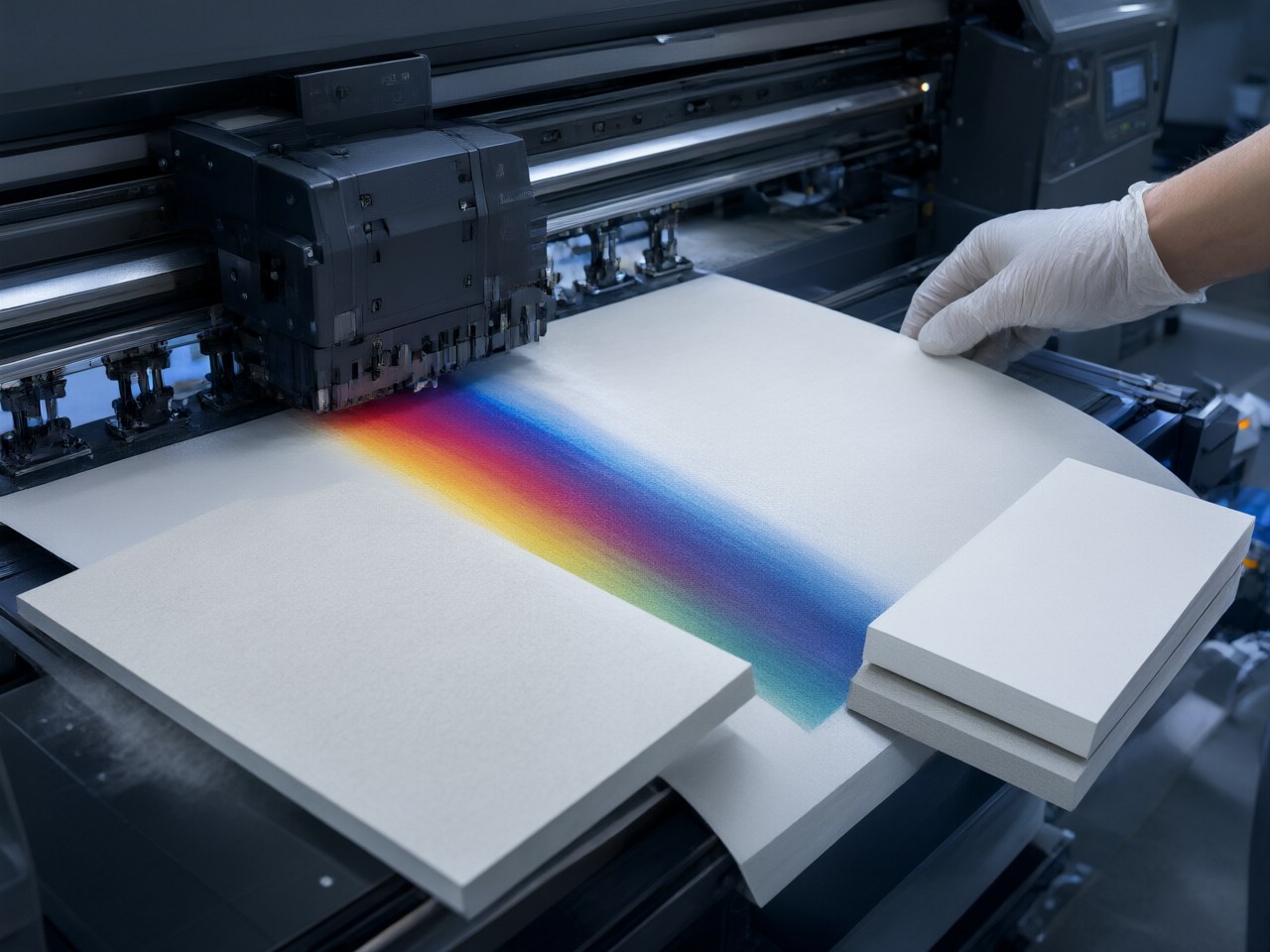
Can I print DPA film on an eco-solvent printer? DPA (K coating) is listed only for wide-format UV inkjet and cannot be used with eco-solvent or hard solvent. For eco-solvent (mild solvent) or HP Latex, use an S-coated part in the self-adhesive inkjet series and choose PSA or WRA from that part’s spec sheet. FS-S22-PSA and FS-S27-PSA are listed for HP Latex only.
Next Steps
1. List the surface for each installation: material, finish, and whether it is smooth or semi-rough. 2. Set the intended display period, and state whether the graphic must come off cleanly. 3. Confirm the printer and ink type: wide-format UV inkjet, eco-solvent (mild solvent), HP Latex, or a label press with offset, flexo or UV-curing inks. 4. Note the roll width or slit width, the face thickness and density series, and the indoor or short-term outdoor service conditions. 5. Contact the Newlife - Flexstone team through the samples and quotation page to request samples, the relevant NMEQS-MACO spec sheets and application engineering support for the trial.
Planning a permanent, removable or air-release graphic? Contact the Flexstone application engineering team through the samples and quotation page. Share the surface, printer and display period, and the team can recommend PSA, WRA or DPA and send matched samples with the relevant spec sheets.
References
1. Guangzhou Newlife New Material Co., Ltd. Specification sheet NMEQS-MACO 294, Flexstone® K-PSA self-adhesive inkjet media, version A0. Available via https://www.stonepapers.net/en/downloads 2. Guangzhou Newlife New Material Co., Ltd. Specification sheet NMEQS-MACO 295, Flexstone® label stock (K · PSA / WRA), version A0. Available via https://www.stonepapers.net/en/downloads 3. Guangzhou Newlife New Material Co., Ltd. Specification sheet NMEQS-MACO 303, Flexstone® Eco-Film DPA air-release film, version A0. Available via https://www.stonepapers.net/en/downloads 4. Guangzhou Newlife New Material Co., Ltd. Label & Hang Tag Solutions (Flexstone solution brochure). Related application page: https://www.stonepapers.net/en/applications/labels-hang-tags 5. Flexstone® website. Self-adhesive constructions (knowledge base). https://www.stonepapers.net/en/knowledge-base/self-adhesive-constructions 6. Flexstone® website. Product data summary. https://www.stonepapers.net/llms-full.txt