What Are the Three Forms of Stone Paper Wallcovering Substrate, and How Do Unbacked, Pre-Laminated and Self-Adhesive Differ?
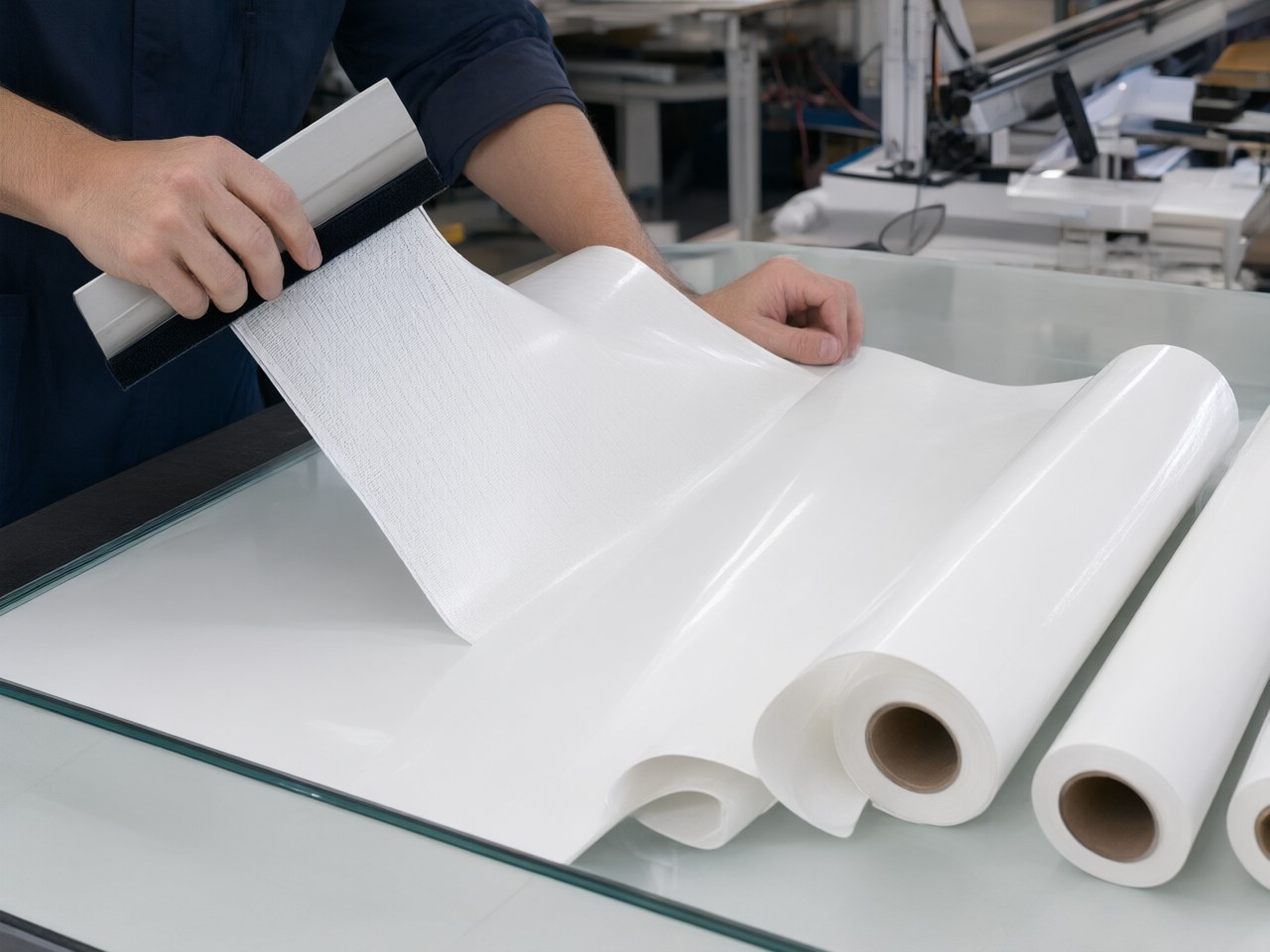
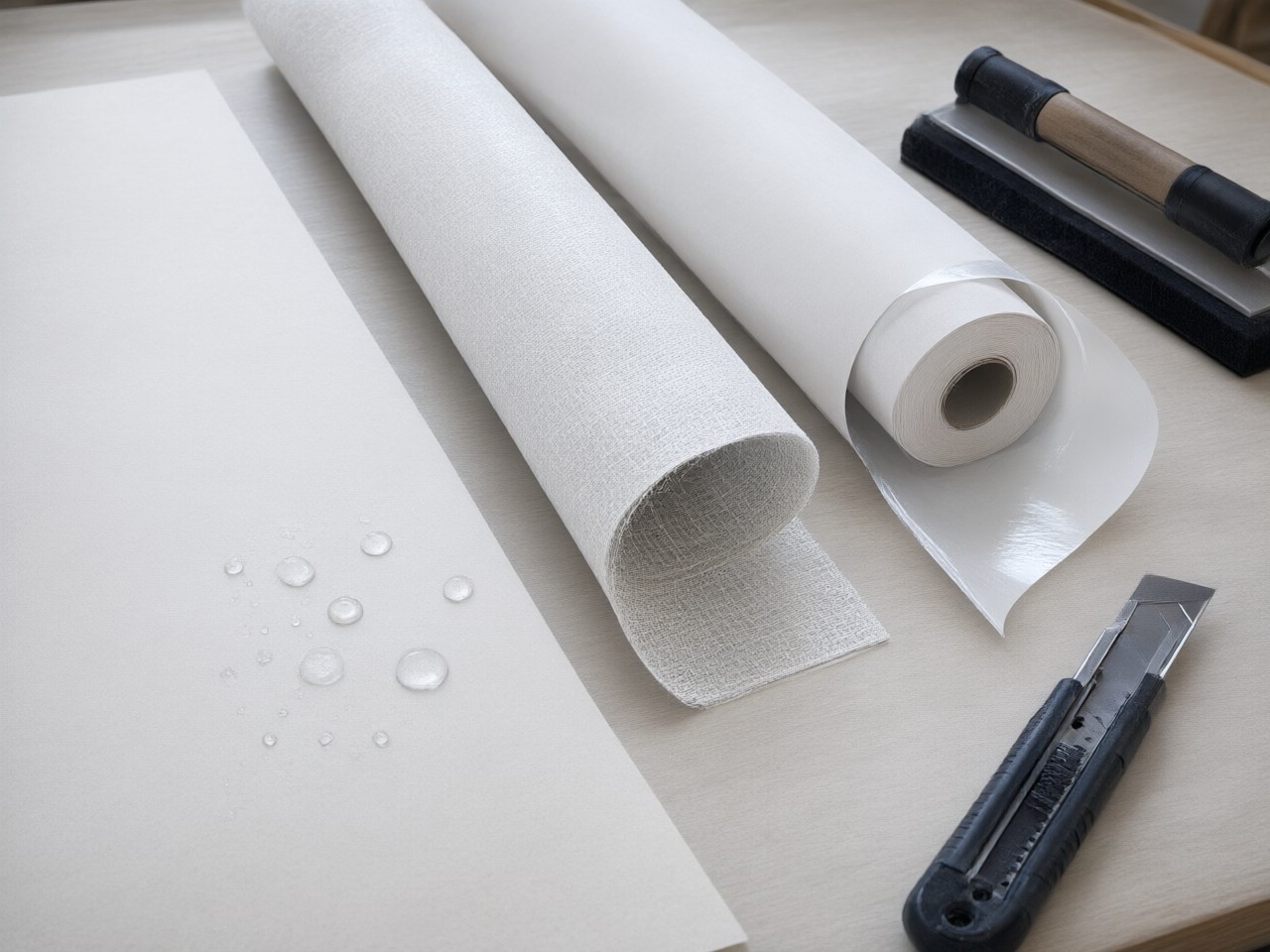
Flexstone stone paper reaches wallcovering mills in three forms. The unbacked form is a face substrate roll that the mill laminates to its own nonwoven or wall-fabric backing. The pre-laminated form arrives with nonwoven or wall fabric already bonded at the Flexstone plant. The self-adhesive form carries a permanent acrylic adhesive and a release liner, so it can be slit and packed as peel-and-stick wallpaper. The three forms use the same mineral-based face material. The choice depends on which steps your plant already runs well: lamination, gravure, embossing, or only slitting and packing.
They are for indoor wallcoverings that need a PVC-free, waterproof, dimensionally stable face. Boundaries on outdoor exposure, fire classification and heat are below.
Comparison of the three wallcovering substrate forms
The fastest way to choose is to match each form to the process steps you want to keep in-house. The table lists what is published for each form and where the data comes from.
| Form | What arrives at your plant | Who laminates the backing | Published print / process routes | Published figures (source) | Main limitation |
|---|---|---|---|---|---|
| Unbacked face substrate | Flexstone roll without backing | Your mill (nonwoven, wall fabric, etc.) | Gravure (industry standard) and digital printing, as stated on the wallcovering substrates page. No coating code is published for this form | Recommended 150–360 g/m² (wallcovering substrates page) | You own the lamination step and its qualification |
| Pre-laminated wall fabric composite (FAB5) | Flexstone bonded to nonwoven or wall fabric | Flexstone, at the factory | Surface printing and embossing on the wallcovering page; K-coated catalog grade is wide-format UV inkjet (NMEQS-MACO 299) | 50 m × 1500 mm roll; opacity ≥85% to ≥95% depending on the specification, by model group not by density series | Backing choice is fixed by the supplied construction |
| Self-adhesive | Flexstone face, adhesive and release liner | Not applicable (adhesive construction) | Wallcovering page: permanent acrylic, then slit and pack. Wide-format S coating: weak solvent, Latex and wide-format UV inkjet; FS-S22-PSA and FS-S27-PSA list HP Latex only. K wide-format rolls: wide-format UV inkjet only (NMEQS-MACO 294 K-PSA, NMEQS-MACO 303 DPA) | 50 m rolls. Widths 1270 / 1370 / 1524 mm, except FS-K15-PSA-80G and FS-K20-PSA-80G at 1270 / 1370 mm. Total thickness by model | Print route, width and total thickness follow the grade, not the form name |
Figures are published per grade group. A figure for the wall fabric composite does not transfer to the self-adhesive rolls, and the reverse is also true. Full sheets are on the downloads page.
Unbacked stone paper for mills that laminate in-house
Choose the unbacked form if your plant already laminates and embosses and you mainly want to replace the PVC or paper face layer. The roll goes straight into your existing route. You choose the backing, the adhesive system, the print process and the emboss pattern.
The wallcovering substrates page lists the following for this form:
- flat running at speed without curl or warp - dimensional stability in gravure and digital printing - a surface coating optimized for ink adhesion and colour reproduction - a warm white opaque face for light and saturated designs - suitability for post-print embossing and debossing
Stone paper contains no cellulose fibre. It is calcium carbonate bound by thermoplastic resin, so it does not swell or shrink with humidity the way a paper face can.
Weight planning for an unbacked face
Because the unbacked form has no backing or adhesive, nominal grammage follows thickness and density:
Nominal grammage (g/m²) ≈ thickness (mm) × density (g/cm³) × 1000
The three density series are FS = 1.0 (soft, paper-like), FM = 1.2 (balanced) and FG = 1.4 (stiff). Selected calculated points:
- 0.15 mm FS ≈ 150 g/m² - 0.25 mm FM ≈ 300 g/m² - 0.30 mm FM ≈ 360 g/m² - 0.30 mm FG ≈ 420 g/m², above the recommended 150–360 g/m² window
Effect on specification. The stiff FG series uses up the grammage window at a thinner gauge than FS or FM. If the finished wallpaper needs a heavy, rigid hand, decide whether that stiffness should come from the face or from your backing.
Effect on purchasing. Face weight per square metre sets how many square metres you get per tonne of face, and how much of the finished weight budget is left for the backing.
This formula applies only to the unbacked face. Backing and adhesive weights are not published as separate values, so the same relation is not an estimate for pre-laminated or self-adhesive constructions.
Pre-laminated wall fabric composite to shorten production
Choose the pre-laminated form if you want to print and emboss without running a lamination line. Flexstone bonds the nonwoven or wall fabric at the factory. You then print the surface and finish the roll.
The catalog item is the wall fabric composite (FAB5), supplied as 50 m × 1500 mm rolls. Face area calculated from that published size is 50 × 1.5 = 75 m² per roll, for job costing and changeover estimates.
The K-coated wall fabric composite is on spec sheet NMEQS-MACO 299. On that sheet the K coating is wide-format UV inkjet. Opacity is published by model group, not by density series, and on listed spec-sheet grades is ≥85% to ≥95% depending on the specification. Plan the print route around that published process. If you intend to run gravure or a heated embossing roll on a pre-laminated web, trial it on your line before production volumes. Grade details are on the wall fabric composite series page.
The trade-off is control. The mill takes the backing Flexstone laminates. If the range depends on a proprietary backing or a specific bond to that backing, the unbacked form keeps those decisions in-house.
Self-adhesive stone paper for peel-and-stick wallpaper
Choose the self-adhesive form if the product is peel-and-stick and the mill's own work is slitting and packing. On the wallcovering substrates page, this form is a permanent acrylic adhesive with a release liner.
Other indoor wall graphics use the wider self-adhesive range. The behaviours below are manufacturer data for those constructions:
| Adhesive | Behaviour (manufacturer data) | Selection note |
|---|---|---|
| PSA | Medium-tack, permanent | Decor meant to stay in place; the wallcovering-page form is permanent acrylic |
| WRA | Water-based, removable | Decor that will be taken down later |
| DPA | Dot-pattern air-release; clean removal from smooth indoor surfaces within 6 months | Large panels on smooth indoor surfaces, where bubble-free application matters |
Holding power for these constructions is 25 × 25 mm, 0.5 kg, 24 h without slip. The facestock is chlorine-free and plasticizer-free.
Print route and width are the grade figures in the comparison table. Match the coating on the sheet to that route. Total thickness depends on the model. Quote the total from the sheet for the grade you buy when you size cutters or set pack counts. See self-adhesive constructions.
Matching the form to your mill's existing capacity
The best option is usually the one that removes your weakest process step while keeping your strongest one.
- You have strong gravure, lamination and embossing lines. Start with the unbacked face. Gravure is the published reference process for this form, and backing know-how stays with your brand. - You print and emboss well but outsource lamination or run it below capacity. Trial the pre-laminated composite. Write the trial around wide-format UV inkjet for the K-coated grade, and run separate trials for any other process. - You run wide-format digital and want a ready-to-install retail product. Use the self-adhesive rolls. Match the coating to your inkjet technology, then match the adhesive to how long the product should stay on the wall. - Your product line covers several of these. Where the same density series is available, keeping one series across forms holds the face hand consistent from sample to sample.
Where stone paper wallcoverings should not be specified
All three forms share the same face material, so the material limits below apply to each of them.
Fire-rated projects. Where a strict fire classification is required, flame-retardant PVC is still the face to specify. A halogen-free flame-retardant formulation is still in development.
Outdoor use. Outdoor durability is lower than PVC. Long-term exterior murals and signage are outside the recommended scope.
Heat. No temperature-resistance figures are published for the wall fabric composite or for self-adhesive grades other than FG-I15-PSA and FG-I20-PSA. Those two FG digital printing grades list long-term (days) 80°C and short-term (minutes) 120°C. FS / FG 2K 0.15–0.30 mm grades list long-term 80°C and short-term 100°C for FS and 120°C for FG. Do not transfer either set of figures to grades that do not publish them. The face contains thermoplastic resin. High-temperature retort and other extreme-heat applications are not suitable. Before production, trial heated embossing, hot lamination and drying tunnels, and check gloss change, emboss definition, curl and backing bond.
Clear effects. Catalog grades are warm white and opaque. Back-lit and see-through effects need a clear film.
Weight. The face is denser than PP pearlescent film, so it weighs more per square metre at the same caliper. Check shipping and handling weights on large rolls.
End of life. Documented routes are shredding and reprocessing, which depends on local collection and recyclers, and energy recovery. Compared with wood-pulp paper, the wallcovering substrates page states about 67% lower production CO₂. That figure is Newlife product data, not a third-party life-cycle assessment. Further comparisons are on the compare page.
Spec sheets and sample trials as verifiable evidence
Treat the named page or spec sheet as the acceptance basis for a trial:
- the wallcovering substrates page for the unbacked grammage - NMEQS-MACO 299 for the wall fabric composite - NMEQS-MACO 294 and 303 for the wide-format K-PSA and DPA rolls
Where a process is not on the sheet, such as gravure on a pre-laminated web or a particular embossing temperature, the Flexstone application engineering team can supply samples for a trial on your line. A practical checklist:
1. Run a short web at production speed. Record register drift and curl at the reel end. 2. Emboss at your standard settings, then step the temperature down before stepping it up. Inspect pattern depth and any gloss change on the face. 3. On laminated constructions, check peel between face and backing after 24 h. 4. On self-adhesive, hang panels on the target wall surfaces, including painted plaster and smooth panels. Record edge and seam lift. 5. Wipe printed samples with water. Check ink rub and colour shift.
FAQ
Can the unbacked form be laminated to my existing nonwoven? Yes. That is the intended use. Flexstone supplies the face; the mill laminates its own backing. Qualify adhesion with your adhesive system on a trial.
Is the pre-laminated composite suitable for gravure? The wallcovering page describes surface printing and embossing on this form. The catalog K-coated composite (NMEQS-MACO 299) lists wide-format UV inkjet. Confirm gravure with a sample run before you commit volume.
Which adhesive suits a peel-and-stick wallpaper that will be taken down later? The wallcovering-page form is permanent acrylic. For a later take-down, the published removable constructions are WRA (water-based removable) and DPA (clean removal from smooth indoor surfaces within 6 months). Test on the actual wall finish.
Why doesn't the grammage formula apply to backed products? Backing and adhesive weights are not published separately. The formula covers only the stone paper face.
Can any of these forms be used where a strict fire classification applies? Specify flame-retardant PVC where a strict fire classification is required. A halogen-free flame-retardant formulation is still in development.
Next steps for a wallcovering substrate enquiry
1. Identify your strongest in-house steps (lamination, gravure, embossing, slitting) and shortlist the matching form. 2. Note the print process and ink type: gravure, wide-format UV inkjet, weak solvent or Latex. 3. State the target face thickness and density series, and the roll width on the sheet (1500 mm for the wall-fabric composite; wide-format self-adhesive widths as published for that grade). 4. For self-adhesive, describe the wall surface and how long the product should stay up. 5. Describe the end-use environment and any fire-classification requirement. 6. Contact the Newlife – Flexstone team through the contact page for samples, the relevant spec sheets and support for the line trial.
The team can match unbacked, pre-laminated and self-adhesive samples to the process, width and adhesive details above.
References
1. Flexstone – Wallcovering Substrates application page. https://www.stonepapers.net/en/applications/wallcovering-substrates 2. Guangzhou Newlife New Material Co., Ltd. – Specification sheet NMEQS-MACO 299 (wall fabric composite, version A0). https://www.stonepapers.net/en/downloads 3. Guangzhou Newlife New Material Co., Ltd. – Specification sheet NMEQS-MACO 294 (K-PSA wide-format rolls, version A0). https://www.stonepapers.net/en/downloads 4. Guangzhou Newlife New Material Co., Ltd. – Specification sheet NMEQS-MACO 303 (Eco-Film DPA air-release film, version A0). https://www.stonepapers.net/en/downloads 5. Flexstone – Wall fabric composite series page. https://www.stonepapers.net/en/products/wall-fabric 6. Flexstone – Self-adhesive constructions. https://www.stonepapers.net/en/knowledge-base/self-adhesive-constructions 7. Flexstone – Compare. https://www.stonepapers.net/en/compare